Friday, September 8, 2017

The Long Dry Summer of 2017.2

...and the rains came


 ...finally, almost 60 millimetres

I only wish I could have captured the sound and fury of it all, the thunderbolts and lightning flashes. 
Thor and Zeus really let us have it, at last.

looking south towards Radda (invisible)

Thursday, September 7, 2017

The Day the Drone flew over Le Ripe

The upside of new technology: aerial photographs


A friendly, invited drone buzzed over Le Ripe this morning like an outsize mosquito and obligingly took some photographs.


Maybe next time it will deliver pizza.

Thursday, August 24, 2017

The Long Dry Summer of 2017.1


Waiting for the rain

these are early morning shots, before the heat sets in

As we walk crunching on the lawns - what say I? - former lawns and meadows, at Le Ripe, I reflect that the place is looking more and more like Australia. The hills have turned prematurely brown, the earth is parched, some bushes and trees, or at least their foliage, have died.
most hills are browner than this, it is quite marked

The drought has been with us since spring. There have been two mediocre rainfalls in the past 4 months or so, totalling about 30ml. It was almost the same last year but at least then we had enjoyed spring rains.
some plants have fallen by the wayside


Saturday, June 10, 2017

Cabbages and Flax

 Surprising Sprouts

At Le Ripe early this spring we had a man with a tractor work over our orchard to tumble out the biggest stones and level the ground for easier mowing.

 The resulting freshly-turned and raked earth cried out for seeds. Grass would have been the obvious choice but inspired by friends, we opted for something prettier.
Our local supplier sells sacks of flax seed. Since the flax flower (linum usitatissimum) is a pretty blue, we thought this would make an attractive first planting before grass seeds were sown in autumn.

Wednesday, April 26, 2017

Cleaning out the Fish Pond


Fishissitudes

  Each year it is a rather sorry and tiring task of mine to clean out our fish pond which we created in a section of the adapted remains of the former laundry trough at Le Ripe.


Tiring for fairly obvious reasons: the trough measures about 2.5 metres by 1.5 and is about 50 centimetres deep and after one year its base is rich with sludge. It has to be completely drained, emptied of its stones and pots and the sludge and rubble swept out through a narrow plughole.


 A sorry task, because each time the fish seem to be the victims of fate and clumsy handling, one way or another. 
It is remarkable to think that our goldfish, left to their own devices in the pond, have survived extreme heat, extreme cold (including 10cm of ice on the surface of the pond), dirty water (this year for various reasons it was 2 years since a clean-out) and amuchina which is a sodium hypochlorite compound used for disinfecting water to deter mosquitoes. This was added when I thought the fish had perished; I was not trying to murder them.

Saturday, April 8, 2017

Oscar Tintori's Garden of Eden


The Citrus Hesperidarium at Pescia

If you drive to the west coast from Florence you may take the Firenze-Mare motorway along the broad valley of the Arno all the way to the sea and Pisa or Lucca. En route you will be treated to views of one of Tuscany's celebrated plant nursery districts (others are to be found further south along the Arno and in Versilia on the coast). 


Battalions of cyprus, platoons of magnolias, brigades of tufted or twisted ornamental bushes, divisions of deciduous trees, regiments of shrubs: an entire army of woody plants marches towards the sea. It is a magnificent display of human enterprise, the varieties of horticulture and human-imposed order.

If you have time (and you really should make time), on the way towards Pisa and the coast, you could make a detour at Pescia (exit at Chiesina Uzzanese) to visit the glorious, perfumed citrus nursery founded by Oscar Tintori. Here you will find gigantic greenhouses covering 2000 square metres and sheltering hundreds of different varieties of citrus plants.


Friday, March 10, 2017

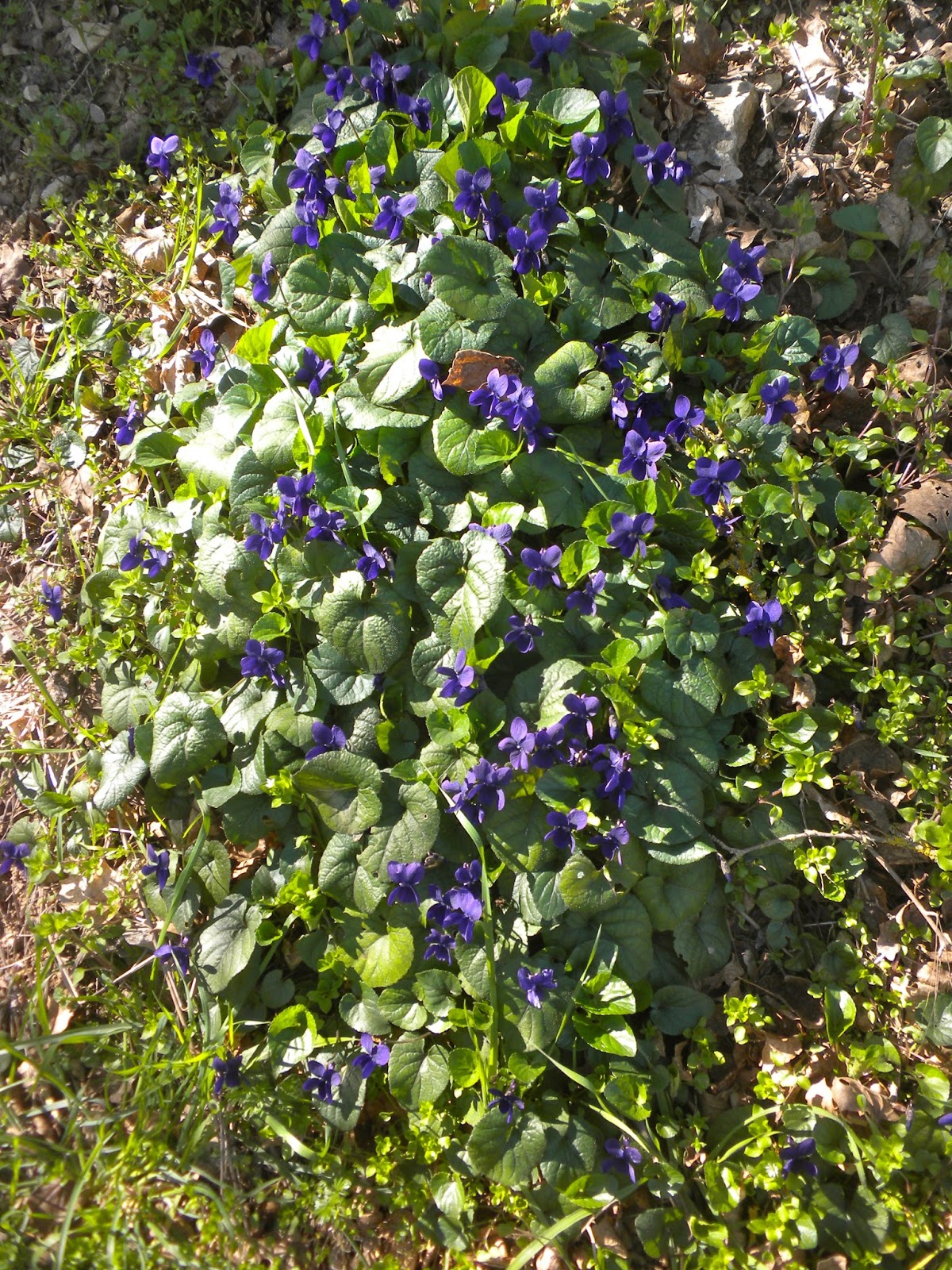
A Clump of Violets

Spring's Herald


Spring arrives officially in about 10 days but there are some exciting harbingers in the garden, not least of which this spectacular clump of violets, all the more precious for being wildflowers.


Saturday, February 25, 2017

Waterfalls

After a Good Rainfall

During most of the year the two streams that run through and beside Le Ripe are completely dry. Even the Pesa river in the valley below dries up in summer, although it is said to continue flowing underground.

Recently Le Ripe received a gift of 82mm or more (over 3.2 inches) of rain in 24 hours, and it shows.

 There are waterfalls everywhere.

Monday, February 20, 2017

From Farm to Forest

Back to Nature

registry map of Le Ripe

When we first arrived at Le Ripe we invited an 'arboreal archaeologist' to examine our trees. We rather fancied that some of the old apple trees might have proved interesting and we thought she could advise us on how to proceed with new plantings at Le Ripe. 

When I showed her the dense woods, full of brambly undergrowth, trees reaching for the sky through thickets of blackthorn and juniper and said something cheerful about it all having gone back to nature she stopped my ramblings with a curt: 'This is land which has degenerated'. 

Although at the time we were shamed into silence, we now have a different perspective (see the post on Monks and Forests) on the fate of forests. 

However, paying respect where respect is due: Le Ripe was once a fully working farm where the native woods provided fuel, forage, fruits and timber for tools; where grapes, cereal crops and fruit trees were cultivated; where livestock grazed; where bamboo and certain trees were planted for their agricultural usefulness. Since it was abandoned in the 1950s or even earlier, the land has been steadily reverting to its pre-agricultural state, 'degenerating' in a sense, although regenerating in another sense.

Until recently, apart from a detail in a neighbour's family shot from 1946 (see below), we had no documentary record of this process, but now, thanks to the internet we have found aerial photographs, starting in 1954, which provide a striking testimony.


2013: for the purposes of comparison with 60 and 70 years ago
The entire area captured in these aerial photographs is of great interest, but for the purposes of our exercise, the Le Ripe property comprises the central area of the photograph, bordered to north and east by the Pesa river, to the south by creeks and to the west by the crest of the forested hill (see map at top of post).


Le Ripe 1946, from the Pesa river (the houses in the foreground belong to Casanuova delle Ripe, a hamlet below Le Ripe): note the terracing, the tracks, the sparse vegetation. these were pastures, grape terraces and fields for growing cereal crops to which the large ricks of oats and wheat bear witness.

Thursday, February 2, 2017

Ballads, Laments and Maledictions


Tuscan Folk Songs


scenes no longer seen in Tuscany

In the 1960s and 70s a young Tuscan woman of Spanish-Swiss parentage took it upon herself to collect, record and perform the traditional songs of Tuscany.
a very young Francesco De Gregori, with Caterina Bueno and Antonio De Rose in 1971
Born in Fiesole, brought up in postwar rural, poor Tuscany with a nanny from the Mugello area, Caterina Bueno was to dedicate her life to the preservation of a precious folk tradition. In her own words, when asked whether she was more interested in ethnomusicological research or performance: "Research! Because
for me performance serves to finance research and to augment it."

Thursday, December 15, 2016

Monday, December 12, 2016

Coming Home

 Autumn Clearing

After some weeks' absence we return to a changed scene: although according to the calendar it is still strictly autumn, it is picturesque autumn no longer: rain, wind and lack of sunlight have drained the colour from the land. Nature is resting. 
the bronze and copper leaves of the hortensia quercifolia, a gift of autumn

Yet the garden is greener, bushier, leggier than when we left. And since our return the sun has been shining every day, which makes for tingling, beaming mornings in which to work outside.