Showing posts with label Wildlife. Show all posts

Thursday, June 14, 2018

The Elusive Golden Oriole

Heard but not seen
male Golden Oriole

The Eurasian Golden Oriole, (Oriolus oriolus) or rigogolo in Italian, winters in Africa and passes through Europe in the summer.
A few years ago a birdwatching visitor reported a fleeting sighting of a yellow and black bird he imagined to be a Golden Oriole in the fields below Le Ripe. 

dowdier female

Thursday, September 24, 2015

A Happy Ending for Mister Fox

The Fox has Fled

Regarding our posts The Downside of a Fence  and Mystery Solved
we are delighted to announce that in all probability, Mr Renard has escaped the confines of our garden where he was inadvertently imprisoned during the installation of our perimeter fence.

Saturday, September 19, 2015

Mystery Solved

The Downside of a Fence part 2

We are now pretty sure of our mystery guest's identity because there have been several signs and, last night, a sighting, plus a convincing confirmation from the internet - to do with smell.


We first thought it might have been a fox. This was partly wishful thinking, because the possibility that a porcupine was enclosed in our garden with all its juicy bulbs, corms and tubers just waiting to be foraged, was just too scary.

Friday, September 11, 2015

The Downside of a Fence

On the Inside Looking Out
(The Downside of a Fence part 1)


 When our fence was installed, over days and weeks, the noise of the men and machines ought to have scared off any residual larger inhabitants left in our garden.
But it seems it didn't.
 

Friday, August 7, 2015

The Fence at Last!

Le Ripe has its Fence at Last


It has been almost two years since the Le Ripe Saga of the Fence began (see side column for the whole gory story).
The principal reason for the Fence was protection against marauding and destructive wildlife.
On this very day we can cut the ribbon, pour the champagne, crow with joy and felicitation, for the Fence has been completed, thanks to our trusty gardening team.

Saturday, July 11, 2015

Bufo bufo pays us a visit

Toad in a Hole
 This morning as I stepped outside to do some work in the garden I was confronted by a toad sitting on the cast iron bars of a drain. 
Possibly he was searching for water. So I decided to offer him some. 

Monday, February 2, 2015

The Birds are Back!

Coming for dinner, not coming 
as dinner
blue tit - cinciarella - Parus caeruleus
For two winters now we have mourned our little birds, the ones that in the winter of 2012 came so merrily to feed on our new bird tables.  
no takers?
We wondered where they had disappeared to: was it the unseasonally warm weather which kept them in more northern climes; was it the scoundrel cat which had discovered it could access the goodies on the bird-table by jumping from the old hay-cutter (goodies signified birds and bird-feed, two for the price of one jump)? 

Sunday, December 14, 2014

The Return of the Wolf III

 Lupus in Fabula 
 or 'Speak of the Devil'


We have good reason to suppose that wolves are inhabiting or at least hunting in our neck of the woods. In the heart of Chianti where, despite our extensive woodlands, civilization (farmhouses, villas, roads, vineyards, olive groves, gardens, villages and towns) makes itself firmly felt. This phenomenon seems to be corroborated by a recent article in The Guardian newspaper.

 Locals have firm evidence that our deer have met their natural predator. The carcass of a roe deer was found mauled, amputated and gutted against a neighbour's fence. The desperate deer had sought refuge inside the fence but was caught, halfway to safety.

Sunday, October 5, 2014

A Vexed and Vexing Question: Hunting in Tuscany

The reality in those hills

What follows is not an apology for hunting, nor is it an outright critique. It is intended as more of a review of the current situation in the region of Tuscany.  

In provincial Tuscany, on the whole, hunting  is considered not only an ancient right, but a necessity. For centuries people lived off the land, relying on their own strengths to make a living, to feed their families: in short, to survive. Hunting was an essential part of this process. In addition, farmers, as all the world over, attempted to protect their flocks, their crops and their families from the incursions of the wild. Once upon a time wolves roamed these hills, and although boar are not indigenous, they were introduced a long time ago.


Friday, May 2, 2014

The Beasts of Le Ripe


Local Fauna, a Taxonomy

Indigenous and introduced, the wildlife at Le Ripe, and in Chianti generally, is varied and abundant. This list only covers interesting four-legged mammals, for birds have been discussed in detail elsewhere: see posts on starlings, bird visitors, the nightingale and feeding birds while bees and a magnificent spider also make appearances in other posts. Traces of all the mammals below have been found in one form or another, and most have been sighted, at one time or another, at Le Ripe.


Wild Boar - Sus Scrofa

Of course this is really a wild sow; the mothers tend to move about in the company of one or two other mothers, with all their young, a kind of mothers and toddlers playgroup. The only time to fear the boar is when the mothers are protecting their young.


Crested Porcupine - Hystrix Cristata

The two most frequent traces of the porcupine: its striped quills which fall out easily when the animal is threatened; and the filching of bulbs from the garden. Bulbs are a special treat for porcupines.


Tuesday, January 7, 2014

The Return of the Wolf Part Two


Wolves again?


At the end of December 2012 during our big snow-in, wolf paw prints were sighted near the village of Lucarelli below Le Ripe.

In the first days of 2014, the carcass of a mauled and half-devoured roe deer was found down by the Pesa river, very close to the village. Locals say the killing is unmistakable: only wolves or wild dogs leave half a carcass in that state.** The next day the remains of the deer had been dragged closer to the river and devoured some more.

canis lupus lupus, Eurasian wolf

Methinks the Wild is closer than we reckoned.  
Yet, if the deer population were controlled in this way it would seem part of the natural order of things.

capreolus capreolus, roe deer
 
**It has been pointed out to me that the deer may have died on its own and been devoured and dragged by foxes: this is a possibility of course, but the wolf story is so much more   exciting, I think I shall stick with that for now. 
                      

Sunday, August 18, 2013

Hazelnut Harvest

Getting in before the wild boar and squirrels

this year's hazlenuts from the cossetted hedge
 
 I used to be surprised when our elderly neighbour, Signor Bonechi, would come up our drive in mid August to shake the hazelnuts out of the trees. It seemed to early: surely hazelnuts are an autumn crop? Over time I have come to realize that Signor Bonechi was simply canny. 

impossible to photograph, our squirrels resemble this black squirrel but are tinier, more feathery-looking and with a deep burgundy tinge to the black

Thursday, July 25, 2013

Pipistrellus pipistrellus

 The Nocturnal Paratroopers

There are bats at Le Ripe and there certainly always have been. When we first arrived to survey the semi-ruins of our future home we discovered bats in the cellar, bats in the bedroom and bats in the barn. Yet they are elusive creatures and for five years now, since the renovations, we have not seen many.


However over the last couple of days I have been lucky enough to sight bats again at Le Ripe. The other evening, at dusk but well before dark, I happened to notice a small, dark round shape zipping out of our bat box (more on this below); I focused my gaze on the bat box and was treated to the sight of a second small round shape zipping out after the first. The image this called to mind when I tried to describe it was of two action film paratrooper commandos bombing out of a helicopter, diving down towards their mission, their parachutes (in this case the bats' wings) still furled behind them.* 

Wednesday, June 19, 2013

A fledgling

  A small incident in the garden
or
The magpie chick that wasn't

adult  Eurasian jay
We thought it was a magpie nest. Large and conical, built in the centre of a cluster of field maples not far from the main house; it seemed to fit the description. As it turned out, we were wrong. One evening as we ate outside, we spied a bird wobbling up and down on a branch of one of the field maples as if it were standing on a diving board. Suddenly it launched itself to fly. Rather than fly, it fluttered earthwards where it made something of a crash landing. 

just landed

Thursday, March 14, 2013

Antipodes

Our Sister Slope

Three Peaks with its three hills and farmhouse

Far away on the other side of the world from Le Ripe, in another hemisphere and in another season, stands Le Ripe's Sister Slope, Three Peaks. Sister Slope, because linked by family ties. And because similar in its aspect, size and topography, if starkly different in its flora and fauna, and considerably different in its climate  (milder in winter than Le Ripe).

Black Angus steer calves eating hay

Home to passing kangaroos and resident wombats, the occasional koala and myriad birds, but also host to introduced species such as fox and rabbit, unlike Le Ripe, Three Peaks is an active farm where steers are raised for market. It contains a spacious one-storey home and its surrounding native garden nestled within 30 hectares of pastureland characterised by three hills which inspired the farm's name.

kangaroo photographed at Three Peaks


wombat photographed at Three Peaks

Tuesday, February 19, 2013

Oh dear the deer


The Beautiful Ratbags

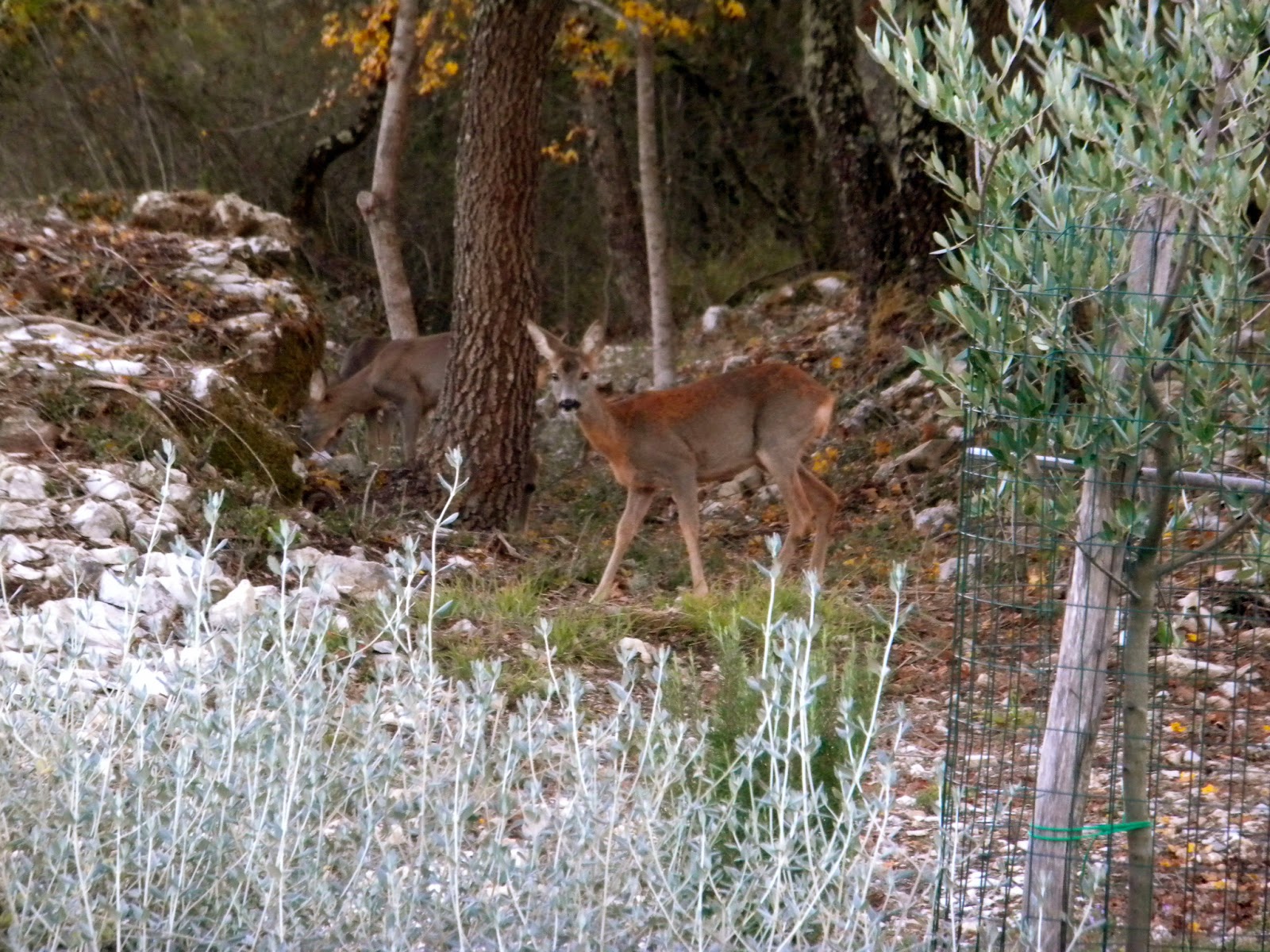
roe doe in late October; note canny cage on right, protecting olive
They are graceful, fleet of foot, soft-eyed and timid. Yet they pose a dilemma.

At first it appears that Dama dama or fallow deer are not indigenous to our region, for they were not in Chianti during the childhoods of older people alive today, when, I have been assured, the only large mammals were hare, fox and badger. Even the porcupine was introduced relatively recently; hence the current dearth of giaggioli, common irises, which used to fill the surrounding countryside, for porcupines adore tubers. 

Fallow deer, rather, were introduced or probably re-introduced, or perhaps returned for lack of predators (see below) since Wikipedia tells us they were native to most of Europe during the last Interglacial, while at the beginning of the Holocene they inhabited the Middle East and some parts of the Mediterranean. We have to blame the Romans for bringing them back to central Europe. Precisely where Chianti stands in this scheme of things is unclear. But these deer have certainly been around a lot longer than we like to think. 

As for the roe deer, Capreolus capreolus, which are stronger and even more agile than fallow deer, jumping higher and faster despite being considerably smaller, they seem to be pretty well indigenous to Eurasia (with the exception of Ireland and smaller islands). However I note: "in the Mediterranean region [they are] largely confined to mountainous regions, and [are] absent or rare at low levels". Our part of Chianti is not mountainous, it is hilly (Le Ripe stands at 330m above sea level), so why have the deer descended below their usual terrain to bother us?


roe deer fawn (roe is the original Bambi) hidden in undergrowth by doe - this location is surprisingly close to our house

Friday, January 18, 2013

Our Visitors

Le Ripe birds

Here is a gallery of some of the birds that visited our bird tables last season, hopefully soon to return!

blue tit - parus caeruleus - cinciarella

chaffinch - fringilla coelebs - fringuello

blackcap - sylvia atricapilla - capinera
This one looks a bit of a rascal

collared dove - streptopelia decaocto - tortora dal collare orientale

greenfinch - carduelis chloris - verdone

nuthatch - sitta europea - picchio muratore
love that Egyptian eye shadow

redstart - phoenicurus phoenicurus - codirosso

                                           
Thanks to the internet for the photos....


Thursday, January 17, 2013

Birdfeed

Where are the birds?

Last autumn/winter we began welcoming birds to Le Ripe in earnest, setting up three bird tables which we kept richly supplied with seeds, scraps, crumbs and water. And so many birds came to eat: robins, magpies, collared doves, redstarts, blackcaps, tits, greenfinches, chaffinches and the delightful nuthatches with their elegant Egyptian eye paint. 
Unfortunately we have very few photos of these birds: we never seem to have the time to watch and wait in order to capture good shots of them.  
blue tits feeding around the trough before it was restored

a redstart on the fence

magpies feeding at one of the bird tables

This winter, however, we have seen very few birds in general. I wonder if it is thanks to the milder weather keeping them in more northern territories, or because I have been rather slow to set out the bird food this year?
Today I decided to set matters right and bought several bags of feed from the shop locals call il Mugnaio, the Miller, in Panzano (once upon a time there was a working mill there). A couple of these products were new to me: panico, which turns out to be foxtail millet, to hang from tree branches, and something called Vigorpast whose ingredients resemble those of the bird puddings my children and I used to create for city birds when we lived in Milan. This sticky feed consists of goodies such as (and I quote): 

"fruits, backery products, vegetable by-products, oils and fats, cereals, vegetable proteins extracts, sugars, yeasts, seeds, mineral substances, natural flavourings.."

But the best part is what this energy bomb is going to do for the darling birds, according to the manufacturer (again I quote verbatim):

"Vigorpast is the best mash for insectivorous and frugivorous birds. The base of its formula is a high content in fruits. It is considered the food more similar to that free birds prefer. It is particularly desirable to BLACKBIRDS,THRUSHES,FIELDFARES, LARKS, NIGHTINGALES, GRAKLES and in general to all birds with thin beaks. 
It favours the general sense of vitality therefore stimulating the tendency to sing."

Now, isn't that charming?
If only we could all boost our vitality in such a way, thereby stimulating 
our tendency to sing.
No doubt the world would be a better place for it.

Thursday, January 3, 2013

Bees!

bees in January


This was the day, January 3rd 2013. 
Soaring blue sky, back-warming sunshine, 
high of 11,3 in the shade, so perhaps 14-15 in the sun?
The winter-flowering honeysuckle 
(lonicera fragrantissima
has been blooming the last few days.
Fragrantissima: the bees must have sensed it.
Today they were out in strength, plundering its blossoms.
A sweet treasure in the heart of winter.


Monday, December 31, 2012

The Return of the Wolf I


Wolves


The photo is not mine, but similar tracks were found in the village of Lucarelli below Le Ripe in the coldest part of last winter after it snowed heavily and stayed so cold that the snow lay on the ground for over a fortnight (a rarity here). The huge, unmistakeable paw prints were seen near our neighbours' smallholding, where sheep, cattle, pigs and geese are raised. 

We had heard that wolves (Canis lupus lupus) had returned to Tuscany, that pairs were sighted near Ferrone (about 10k north of here, towards Florence), that the packs are monitored with electronic tags; but we had not believed they would roam around our part of Chianti. When we did speculate about creatures like bears and wolves, the reaction was mixed: there were those of us who relished the thought of such wild and fierce animals in our woods; others were less sanguine.

In a fascinating article from the Economist (link below) about the return of the wolf in Western Europe - and beyond, we learn that young wolves will wander as far as 1000k in search of a mate; so what was Lucarelli to a lone wolf from the Ferrone pack? A doddle!

So we may have more sightings this winter, may hear them howl in our woods. The deer will have to reckon with them, but as the article points out, the deer have overrun this area; a natural predator is perhaps needed.

From the Economist: The wolf returns - Call of the wild After millennia spent exterminating them, humanity is protecting wolves. Numbers have risen again—and so have ancient resentments Dec 22nd 2012  
http://www.economist.com/news/christmas/21568656-after-millennia-spent-exterminating-them-humanity-protecting-wolves-numbers-have-risen
quite a cutie really