Showing posts with label Contrasts. Show all posts
Sunday, January 3, 2016
Tuesday, August 11, 2015
The Gardens of Villa Marlia near Lucca
The Ups and Downs
of an
Historic Garden
It is true that we arrived at Villa Marlia, Capannori, not far from Lucca, on an extremely hot summer's day during an extremely hot and dry summer. Yet our overriding first impression of the gardens was of neglect and decay.This impression was soon softened by splendid perspectives and some truly special gardens and features (the massive topiary hedges and bushes are most striking), but despite these, it is clear that the property has seen better days. It needs some saving.

of an
Historic Garden
It is true that we arrived at Villa Marlia, Capannori, not far from Lucca, on an extremely hot summer's day during an extremely hot and dry summer. Yet our overriding first impression of the gardens was of neglect and decay.This impression was soon softened by splendid perspectives and some truly special gardens and features (the massive topiary hedges and bushes are most striking), but despite these, it is clear that the property has seen better days. It needs some saving.
| a portion of the lawn at Villa Marlia, with its spectacular topiary columns and spheres; one has to imagine the grass as green as per Capability Brown landscaping which it clearly imitates |
![]() |
| magnificent, tall hedges leading to Clock House |
Friday, July 11, 2014
Monte Oliveto Maggiore and Sant'Antimo
The Two Abbeys
If you are travelling south of Siena, to the area known as the Crete Senesi (literally the Sienese Clays), and if you are interested in medieval and renaissance history, art and architecture, you will have to make a stop at the abbeys of Monte Oliveto Maggiore and Sant'Antimo, both founded by the Benedictines. The abbeys are interesting in themselves for several reasons, but the contrast between the two is also fascinating.
Monte Oliveto sprawls above a clay cliff on a hill south of Asciano. It is a considerable complex of brick buildings; bricks are the material of choice in this area: the clay they are made from is ubiquitous.
Sant'Antimo on the other hand sits cradled in a valley of the river Starcia, surrounded by olives and fields of wheat. It is south of Montalcino, not far from Monte Amiata. Sant'Antimo is partly in ruins and on a much smaller scale than its neighbour. It is built of local travertine and alabaster-onyx.
First to the larger abbey, the working monastery which produces wine, oil, liqueurs, pulses and spelt in its still extensive territory while the monks restore ancient manuscripts.
Friday, January 17, 2014
Saturday, August 24, 2013
Sharecropping in Tuscany
Slavery, Serfdom and Mezzadria
It
is all very well for us to wax romantic over the Tuscan countryside,
its rows of smoky olives, the lines of vines, its ancient drystone
terracing, handsome stone farmhouses and grand villas. These
elements are indeed harmonious and pleasing to the eye. But their beauty
may be incidental. Sadly,
this marriage of natural materials and the painstaking husbandry of the
land are also testimony to an ancient institution which at best
discouraged innovation and at worst was downright exploitative and extremely harsh, at least for many.

Thursday, March 14, 2013
Antipodes
Far away on the other side of the world from Le Ripe, in another hemisphere and in another season, stands Le Ripe's Sister Slope, Three Peaks. Sister Slope, because linked by family ties. And because similar in its aspect, size and topography, if starkly different in its flora and fauna, and considerably different in its climate (milder in winter than Le Ripe).
| Black Angus steer calves eating hay |
Home to passing kangaroos and resident wombats, the occasional koala and myriad birds, but also host to introduced species such as fox and rabbit, unlike Le Ripe, Three Peaks is an active farm where steers are raised for market. It contains a spacious one-storey home and its surrounding native garden nestled within 30 hectares of pastureland characterised by three hills which inspired the farm's name.
| kangaroo photographed at Three Peaks |
| wombat photographed at Three Peaks |
Monday, February 11, 2013
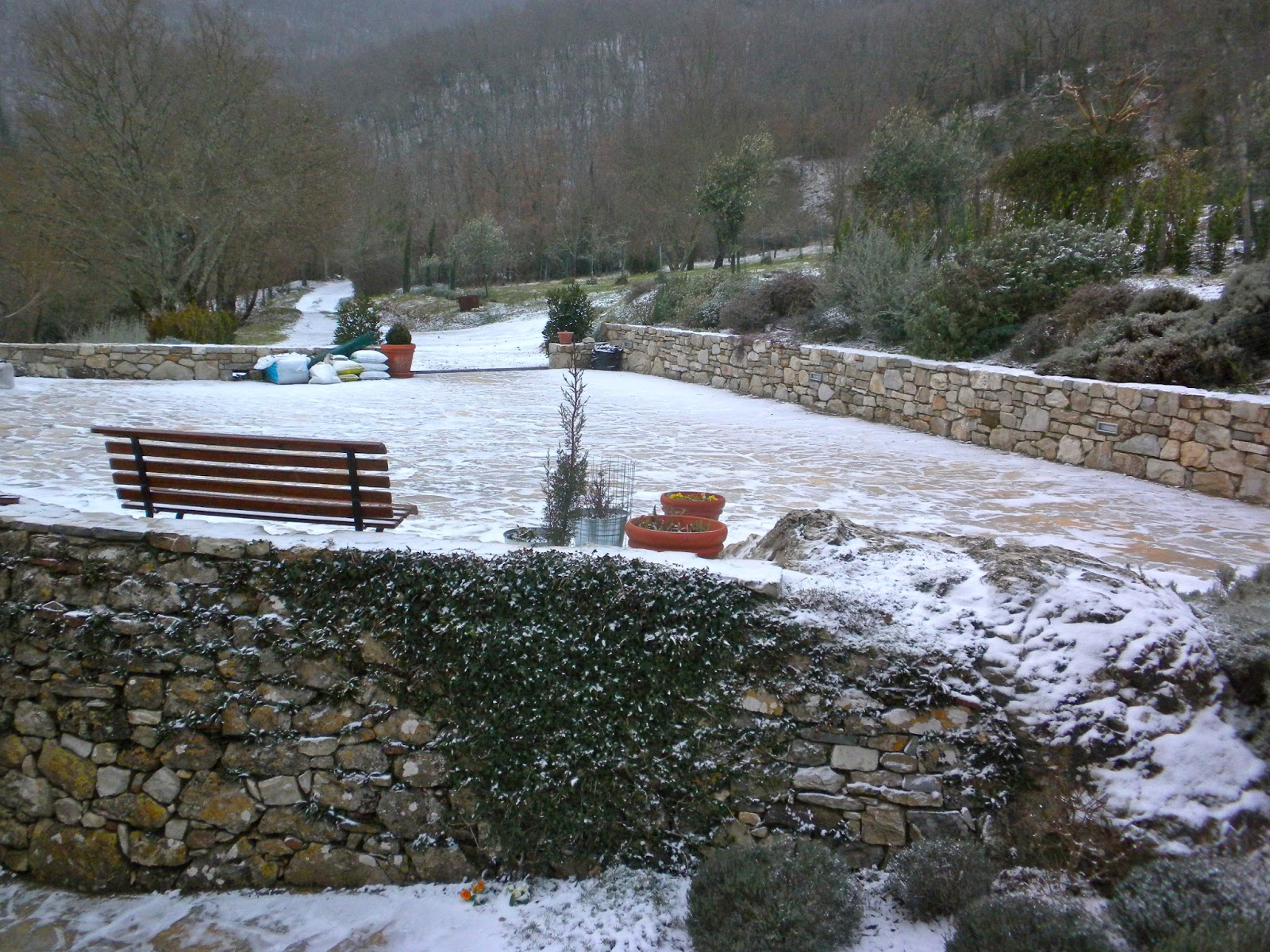
Snow
Horizontal Snow
8am 10am
The snow is falling, or rather flying by, since the wind is carrying it horizontally. It must be rather wet as not much is sticking. But that always reminds me of the priceless moment in Fellini's Amarcord when someone says "It won't stick", "Non attacca mica" and the next day people are walking through tall walls of frozen snow...Have a look here where you can also watch the touching scene with the peacock:
Amarcord 'nevone' scene
They say that it will be raining by the afternoon, so I thought to record what we hope is a fleeting, sleeting snowstorm. Shall keep you posted....
1300: It is now raining heavily. No risk of an Amarcord scenario...
Wednesday, November 14, 2012
Australia
Not Le Ripe!
This is not Le Ripe,
not Tuscany nor even any other part of Italy.
Here it is spring,
there are swallows, wrens, honeyeaters, lorikeets, magpies, cockatoos, willy
wagtails and sacred ibis
I write from
Australia, from another landscape and another season.
| flowering gum |
nesting, feeding,
soaring, singing, darting and hopping everywhere.
Butterflies
on the native shrubs, bees on the lavender, blossom on the trees.
How
lucky to enjoy a breath of spring before winter arrives in the north...
Monday, August 27, 2012
Southern Bounty
| part of the tomato plantation 2012 |
Pomodori
No, this is not Le Ripe, this is my sister in law's farm in southern Italy. We visited them last week and witnessed the incredibly labour-intensive job of making bottled tomato passata with their wonderful Rio Grande tomatoes. Here are just a glimpse of their organic tomato plantation and one moment of the 'procedura' as they call the entire process once the tomatoes have been harvested.
| cooking the washed, selected tomatoes |
First the tomatoes are washed, chopped both for quicker cooking and to check that they are sound inside (this does not happen in industrial processes) and set to cook in enormous saucepans. They boil at least two hours until they have reduced and softened. Salt is added at the end. This is for taste and to help preserve the sauce. Then the hot pulp is poured through a small machine which mashes the tomatoes, discarding the seeds and skins. This is the only mechanized aspect. The 'passata' - so-called because it has been 'passed' through the filter and become a rich red sauce - is immediately bottled with some leaves of basil. The bottles are piled in large saucepans filled with water and boil for about two hours; they are then left to cool overnight.
This year my sister in law, who is a real hero, will make 3000 half-kilo bottles of passata sauce with a handful of helpers. If anyone is interested in buying this wonderful, fresh, natural, organic tomato sauce they can have a look at this blog which also shows images of the 'procedura'.
The best use for the passata sauce (which can of course be adapted to countless recipes) is to simply pour it over a dish of freshly-cooked 'al dente' pasta, add some good olive oil and maybe parmesan and fresh basil.
| fruit of earth and sun |
It is fruit of the earth and the sun,
the best of the best!
If you would like to find out more about my sister in law's produce, have a look at their site.
Saturday, August 18, 2012
Threshing Floor
| the aia in 2003 |
| similar view in 2012 |
Comparisons
The second photo is a recent view of the restored 'aia' and the old dry stone wall. The 'aia' has been enlarged but we found a portion of its paving stones beneath the brambles and earth. The farmers used to fill the gaps between the paving stones with broken crockery, pottery, any other refuse (which was very little: you didn't waste anything in those days) and manure mixed with straw, which compacted and dried very nicely. What effect it had on the threshed wheat is anyone's guess. The engineer who oversaw our works at Le Ripe wanted to demolish the wall, so that the main house would be more visible. "Over my dead body," was my reply. There are many other dry stone walls on the property, mostly crumbling or covered with earth after decades of neglect. We would love to restore them gradually; the irony is that it is hard to find a builder willing to do the job. Perhaps because it takes longer, because it's a dying skill, or because they really believe that cement lasts longer, as they claim. My response is that the Egyptian pyramids are dry stone and they seem to have lasted pretty well.
Subscribe to:
Posts (Atom)