
Updates from the hills of Tuscany, a restored farmhouse in Chianti, midway between Florence and Siena. We write about local history and culture, life in Tuscany, the seasonal changes, pleasures of the garden and country kitchen, local stories and encounters with wildlife.
Thursday, December 15, 2016


Monday, December 12, 2016
Coming Home
Autumn Clearing
After some weeks' absence we return to a changed scene: although according to the calendar it is still strictly autumn, it is picturesque autumn no longer: rain, wind and lack of sunlight have drained the colour from the land. Nature is resting.
 |
| the bronze and copper leaves of the hortensia quercifolia, a gift of autumn |
Yet the garden is greener, bushier, leggier than when we left. And since our return the sun has been shining every day, which makes for tingling, beaming mornings in which to work outside.
Tuesday, October 4, 2016
Autumn in the Campi di Sotto at Le Ripe
Quiet Prospects
 |
| a handsome hawthorn tree in berry |
Clearing the lower meadows at Le Ripe is a yearly job, as described in 2013. It keeps the brambles and bamboo down, encourages grass and makes for pleasant walks.
Thursday, September 22, 2016
Abbadia San Salvatore, on the slopes of Monte Amiata
A Town Full of Surprises
 |
| Monte Amiata |
It is not where most tourists stop on their way around Monte Amiata in southern Tuscany. Abbadia San Salvatore is a township of 6000 souls on the northern slopes of Tuscany's most easily identifiable mountain. Unassuming and ordinary, it is the sort of place you drive through hurriedly, on your way to somewhere interesting.

And yet we stopped: was it that lunch beckoned, or was it that we noticed a sign proclaiming Abbadia San Salvatore as the home of an ancient Bible? Somehow the quest for lunch and our curiosity combined to make us stop. We would discover that this seemingly dull, grey town held several surprises.
Thursday, September 15, 2016
The Garden at Villa La Foce
Foreigners in Val d'Orcia
 |
| Cecil Pinsent's closed green garden at La Foce with its crisp hedges. Monte Amiata is palely visible to the south-east |
If you look at the historical black and white photographs on the Villa La Foce website, as backdrop to the depictions of hardworking and celebrating sharecropping farmers, you will see a lunar landscape: harsh, barren-looking hills, and stretches of empty terrain succumbing to the plough for the first time. Today's intensely-cultivated, ordered and verdant sweep of valley and hills with the famous cypress-lined road winding up the hill opposite La Foce were unimaginable 100 years ago.
 |
| Val d'Orcia before the new owners of La Foce intervened |
 |
| This ostensibly timeless scene has come to symbolise Tuscany, despite the fact that it represents only the area south of Siena, that it is completely man-made and of recent creation, and that its creators were a British garden designer, a British-American woman and her Florentine husband. |
Sunday, August 28, 2016
A Drought in Chianti
Where is the rain?
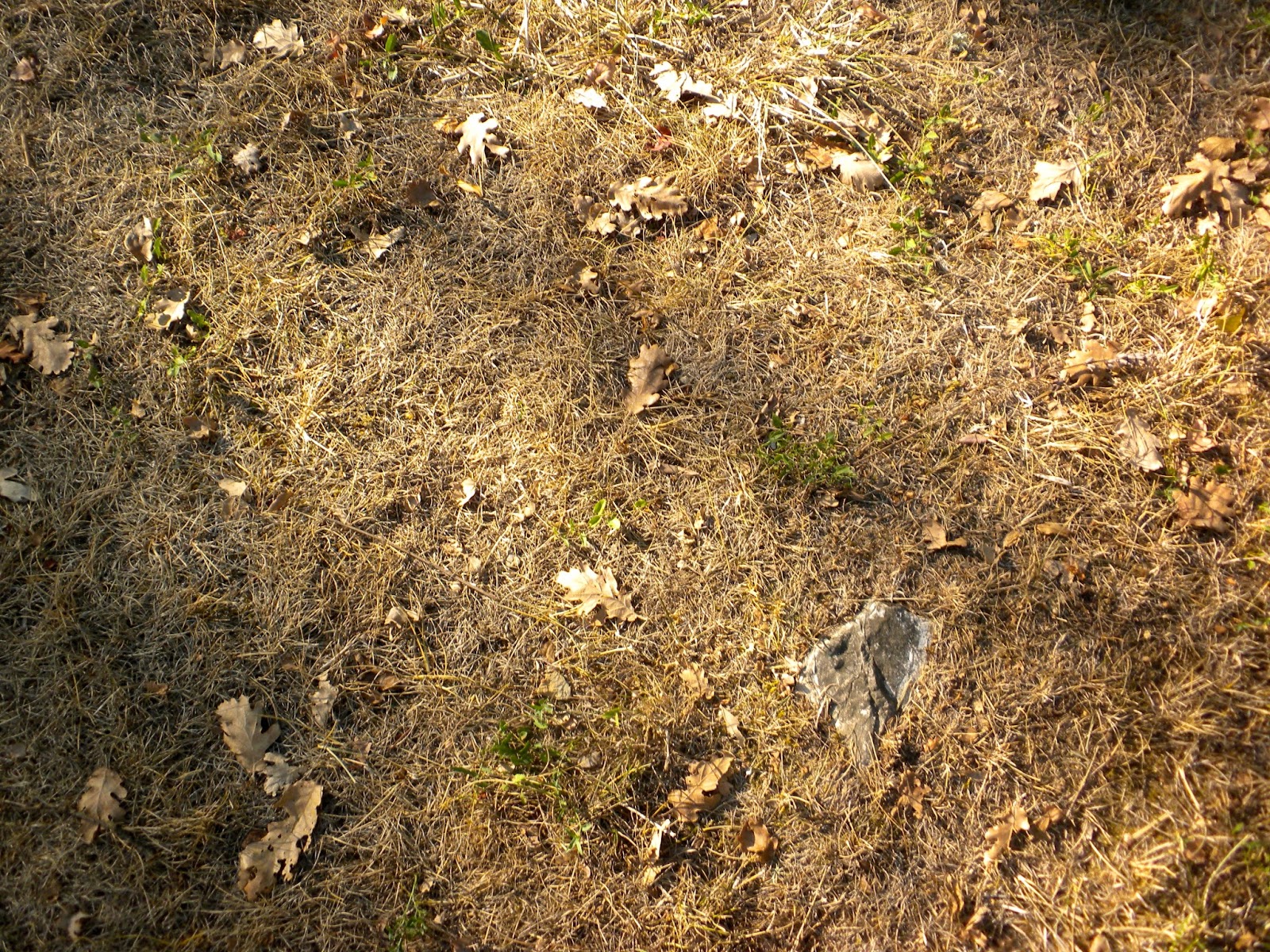 |
| the parched earth; grass non-existent; dead leaves from tired trees |
 |
| even the St John's Wort looks exhausted |
Monday, August 8, 2016
Art in the Wilds of Chianti
Sculptures in the Forest
Hidden in the hills about 14 kilometres north of Siena, is a small but interesting sculpture park. Privately-owned and run by a cultural association, the park was opened in 2004. Its founders, Rosalba and Piero Giadrossi, bought and converted seven hectares of wood formerly fenced for raising wild boar.
 |
| horribly kitsch, this installation does raise a smile at the park entrance |
Except for the amphitheatre area near the entrance, the park is really a wilderness; which makes it all the more interesting. Evergreen oak (quercus ilex) and other oaks, cistus and broom provide a shady and sometimes colourful setting for thirty-odd sculptures and installations.
 |
| the Mondrian-influenced ticket-office and shop; even the parking area has a hint of artfulness about it |
Monday, July 11, 2016
Tending the Rhubarb and Tomato Jungles
The pleasures of a vegetable garden
 |
| butternut pumpkin flowers |
Tuesday, June 21, 2016
Villa Poggio Torselli
The Queen of Villas and her Garden
 |
| Villa Torselli seen from its cypress-lined avenue, a perspective visible when driving along the road from San Casciano north towards Ospitaletto. Apparently dubbed the Queen of Villas (although when and by whom is unclear) |
 |
| the austere facade is surmounted by terracotta sculptures of the four seasons, a theme reiterated throughout the villa and the leitmotif of the garden, not surprisingly |
 |
| Yes, that is Florence 8 kilometres to the north and yes, that is the Duomo, barely perceptible right of centre, although to the eye it was quite distinct |
Monday, May 30, 2016
Museum of the Works of the Cathedral, Florence
The Latest Reincarnation of the Flower of Florence
overview:


The Romans called Florence Florentia. Since the 11th century the city's crest has been the giglio or lily (fleur-de-lis but in fact a stylised iris). Struck in Florence in 1252, the first commercially important gold coin in Europe was called the fiorino -florin- for this reason, and bore the fiordaliso on its obverse side, with Saint John the Baptist, Florence's patron saint, on the reverse. Florence's imposing and iconic Cathedral (or as it is called here, Duomo), is dedicated to Saint Mary of the Flower while the Baptistery is dedicated to Saint John the Baptist. All this is just a roundabout way of underlining the symbolic potency of the flower to Florence's story.
 |
| Sculptures in the brand-new light-filled atrium |
Santa Maria del Fiore was commissioned in 1294 by the Commune of Florence to replace Santa Maria Reparata (a church which, in my view, occupied the available space far more appropriately than its successor). Initially the 'Opera' referred to the institution which financed and oversaw the construction of the Duomo; over time the Opera evolved to oversee the Cathedral's continual conservation and decoration and incorporate the Baptistery (completed in 1128), Giotto's Belltower (begun in 1334) and the Museum.
Monday, May 16, 2016
Palazzo Corsini and the Artisans
Artigianato e Palazzo
A high-end craft fair in a special setting
A high-end craft fair in a special setting

 |
| the loggia of Palazzo Corsini, a former casinò or hunting lodge which was in fact a villa surrounded by a garden; the many Greek, Latin and Etruscan plaques on the villa wall were collected by an 18th century Corsini |
 |
| the setting for the annual craft fair: in the 17th century the sculptures were placed on pedestals of decreasing height to give a greater sense of depth and perspective from the loggia. Some of the original sculptures are now housed in the Bargello while others are at either end of the bridge of the Santa Trinità. |
 |
| one of the barn-like limonaie or lemonaries where 130-plus citrus trees overwinter in their huge terracotta pots |
For the past 22 years, each May, in the middle of the month, a unique range of arts and crafts is on display in a unique Florentine location.
 |
| the parterre: neat box hedging is filled with sumptuous peonies; teucrium, cistus, roses and lavender abound - recent departures from the original purely baroque setting |
Tuesday, April 19, 2016
Orchids in the field
...and a small mystery to solve
Last May we discovered and discussed an unusual orchid, Ophrys apifera which had appeared in our garden. This year, in mid-April different specimens of orchid, glimpsed in the past but now more abundant, probably thanks to the Lack of Deer, are sprouting and budding in the lengthening grass of the more field-like areas of the garden.

This orchid might belong to the pyramidalis species of the Anacamptis genus of the Orchidaceae family, but doubts persist about colour and scent. I quote: The colour of the flower varies from pink to purple, or rarely white, and the scent is described as "foxy".
Subscribe to:
Posts (Atom)