Sunday, November 23, 2014

Olive Oil 3

The sad tale of the 2014 olive débacle


Absent from Tuscany for a while, I nevertheless felt drawn to report from afar on this year's disastrous olive harvest. Trawling the internet for information I came across a site which says everything I would have liked to say. 

I can think of nothing more suitable than to alert readers to this page written by someone who has experienced the debacle in first person. The olives on our 18 trees were equally horrid this year, but we don't harvest them for oil. Yet we are equally affected: this year good local oil will be impossible to come by. 
And there is more bad news in 2015: Xylella fastidiosa


For more upbeat posts on olive oil, see my Olive Oil 1 and Olive Oil 2

We now have to hope for a good, cold winter and a dry summer for the 2015 harvest
 

Thursday, October 30, 2014

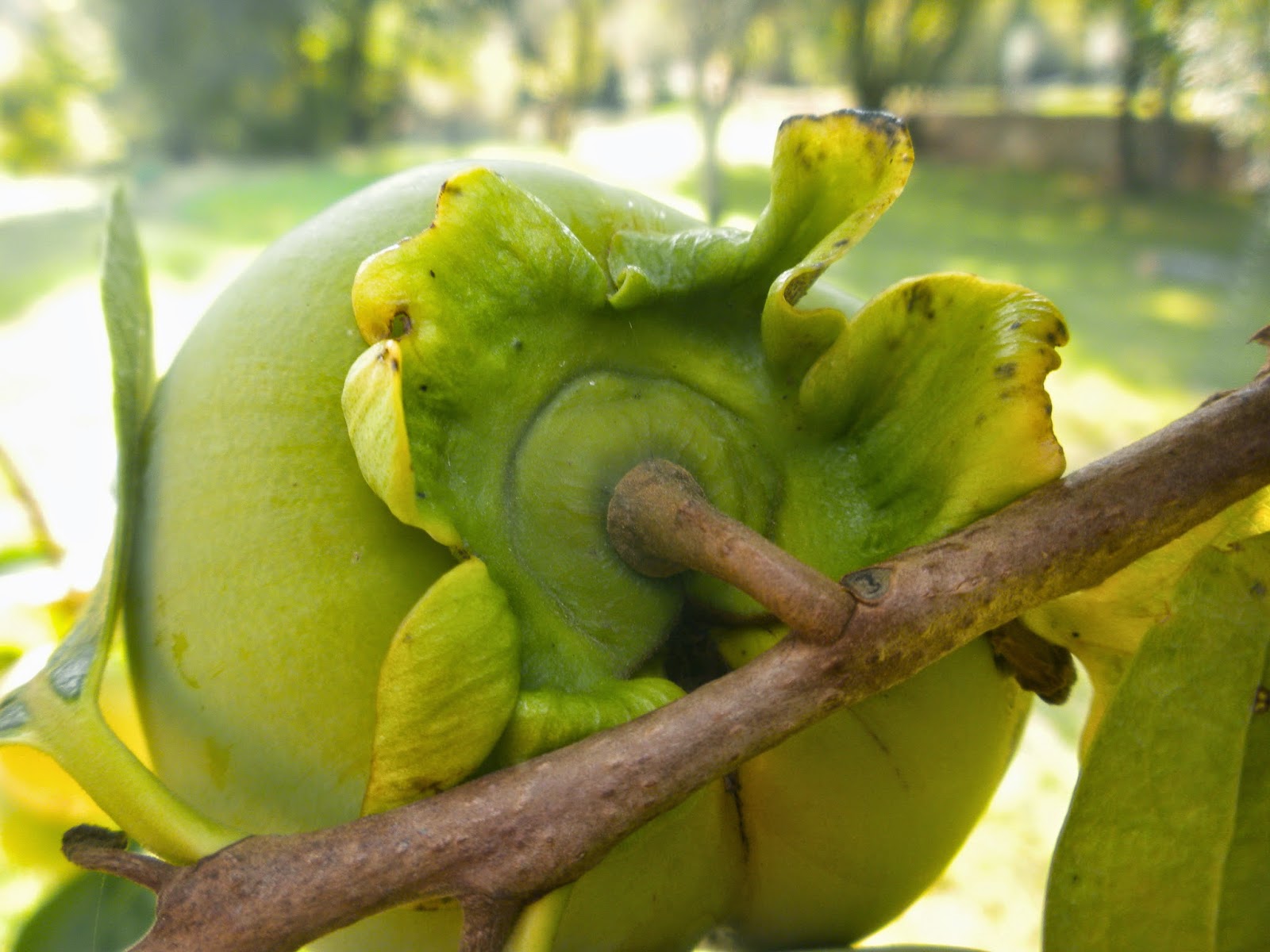
Fruit of the Month: the persimmon

Ripeness is All
 
Of the genus diospyros, family Ebenaceae - which is the family of the ebony tree - the most widely consumed is the Asian persimmon Diospyros kaki. Diospyros comes from Greek, meaning divine fruit or literally, 'wheat of Zeus' otherwise translated as 'Jove's fire' or 'God's pear'. In modern Greek it is called lotos and associated with the food of the lotus-eaters in the Odyssey, although there are multiple candidates for this honour. Interestingly, it has several names in Italian: loto in the south, diosporo in central Italy, cachi or kaki in the north.


The pretty word 'persimmon' comes from Native American Algonquian pessamin, strangely meaning dry fruit. I wonder if this refers to the persimmon's astringency when under-ripe, which leaves the mouth chalky-dry, thanks to the fruit's high levels of tannins. To custom-ripen or 'blet' in the home, store the persimmons in a pot with some apples, pears or bananas which exude the ethylene needed for ripening. Alternatively, persimmons can be ripened through freezing.


Sunday, October 26, 2014

Florence's Slow Food Hall

il Mercato Centrale
- an historic market revisited


Florence's central market, located near San Lorenzo and the touristy outdoor market, is a piece of Florentine's domestic history. There are those of us who visited it as young tourists, to buy peaches for our picnic lunches in the Boboli gardens, or who recall 'the market gardeners and wild herb foragers who would sell their pickings much as in the Mayan markets of yore', to quote a friend. 
Nowadays even the ground floor stalls, shown above, look more like upmarket shops than market stalls.
This does not appear to detract from the quality of their ware although it probably affects the prices. All they same, they seemed to be humming when we visited on a weekday morning.
Yet this post focuses on the first floor of the market which has been transformed from the gritty, colourful, rustic reality of the past into a stylish, cheerful, (upmarket in quality but not, it appears, in price), food hall crammed with goodies. Since spring 2014, this is where the hungry working Florentine or the tourist who is unable to deal with all the raw produce downstairs, can come to savour the finished products. 
As you climb the stairs (or take an escalator) to the first floor the first thing you see is the attractive architecture of the old market: cast iron neo-classical pillars, pietra serena columns, overarching wrought iron girding and tall arched windows which let in considerable natural light. 


Monday, October 20, 2014

The Return of the Robin

Who killed Cock Robin?


     Who killed Cock Robin?
        I, said the Sparrow,
        with my bow and arrow,
        I killed Cock Robin.

        Who saw him die?
        I, said the Fly,
        with my little eye,
        I saw him die.


        Who caught his blood?
        I, said the Fish,
        with my little dish,
        I caught his blood.

        Who'll make the shroud?
        I, said the Beetle,
        with my thread and needle,
        I'll make the shroud.

        Who'll dig his grave?
        I, said the Owl,
        with my little trowel,
        I'll dig his grave.

        Who'll be the parson?
        I, said the Rook,
        with my little book,
        I'll be the parson.

        Who'll be the clerk?
        I, said the Lark,
        if it's not in the dark,
        I'll be the clerk.

        Who'll carry the link?
        I, said the Linnet,
        I'll fetch it in a minute,
        I'll carry the link.

        Who'll be chief mourner?
        I, said the Dove,
        I mourn for my love,
        I'll be chief mourner.

        Who'll carry the coffin?
        I, said the Kite,
        if it's not through the night,
        I'll carry the coffin.

        Who'll bear the pall?
        We, said the Wren,
        both the cock and the hen,
        We'll bear the pall.

        Who'll sing a psalm?
        I, said the Thrush,
        as she sat on a bush,
        I'll sing a psalm.

        Who'll toll the bell?
        I said the Bull,
        I am strong, I can pull,
        I'll toll the bell.

        All the birds of the air
        fell a-sighing and a-sobbing,
        when they heard the bell toll
        for poor Cock Robin.

 
The first robin redbreast of the cold season appeared yesterday in our garden and the lines of this old rhyme came to mind. 


Tuesday, October 7, 2014

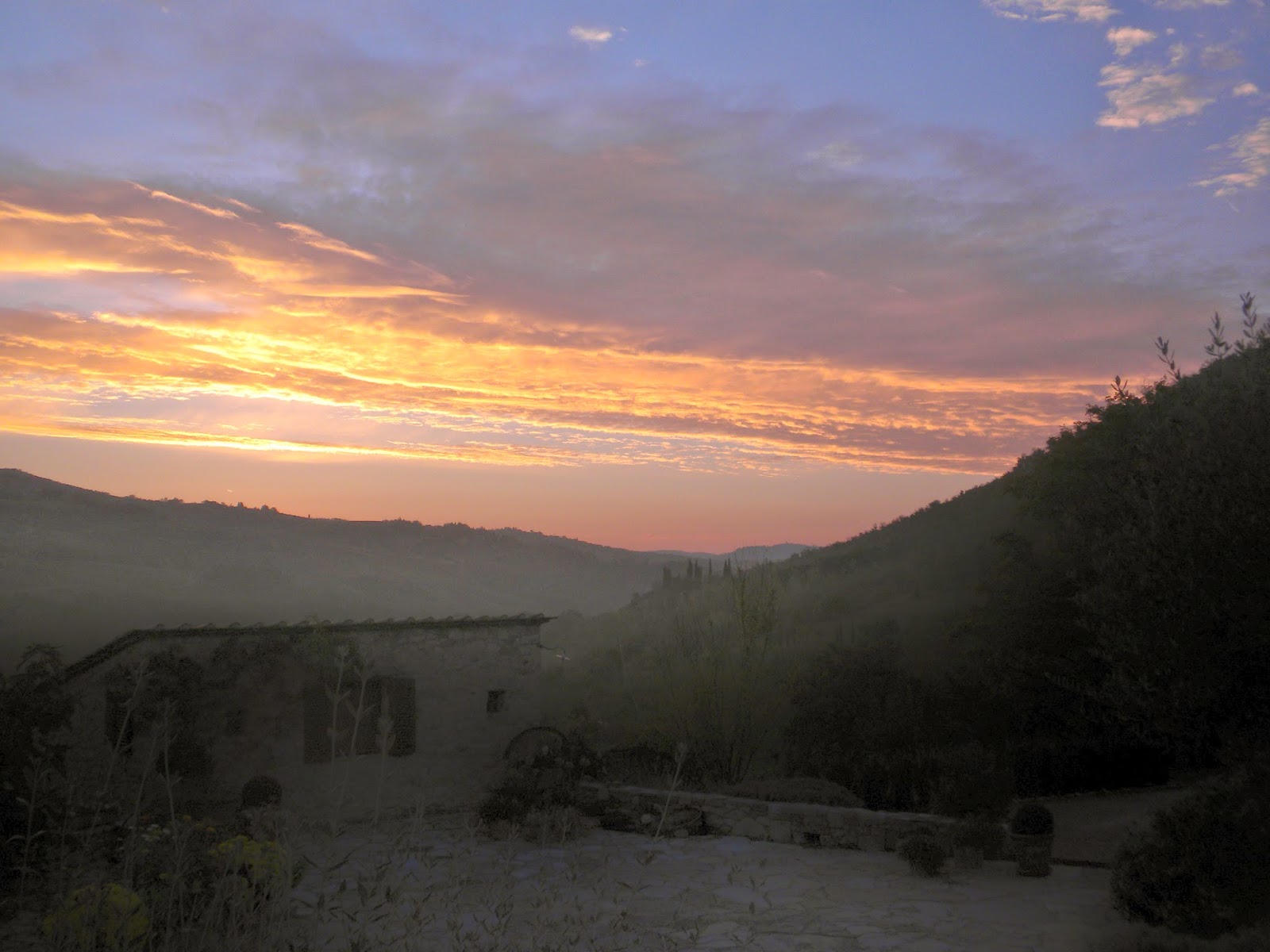
Autumn morning


looking towards Radda around 7am

 the garden a few minutes later


Sunday, October 5, 2014

A Vexed and Vexing Question: Hunting in Tuscany

The reality in those hills

What follows is not an apology for hunting, nor is it an outright critique. It is intended as more of a review of the current situation in the region of Tuscany.  

In provincial Tuscany, on the whole, hunting  is considered not only an ancient right, but a necessity. For centuries people lived off the land, relying on their own strengths to make a living, to feed their families: in short, to survive. Hunting was an essential part of this process. In addition, farmers, as all the world over, attempted to protect their flocks, their crops and their families from the incursions of the wild. Once upon a time wolves roamed these hills, and although boar are not indigenous, they were introduced a long time ago.


Saturday, September 20, 2014

Chianti Classico and the Panzano Wine Festival

Vino al Vino
2014


Each year for the past 19 years the 20 or so wine producers from the area around Panzano in Chianti gather in the main square of the town to introduce their labels to the public. For the modest sum of 15 euros the taster acquires a glass (plus a glass-holder to hang about the neck and a handy booklet for taking notes) and is free to taste any of the local wines on display.
representatives (in no particular order), from the vineyards below

CandialleCasaloste, Castello dei Rampolla, Cennatoio, Fattoria La Quercia, Fattoria Rignana, Fontodi, Il Molino di Grace, Il Palagio, La Massa, Le Fonti, Le Cinciole, Montebernardi, Panzanello, Renzo Marinai, Tenuta degli Dei, Vecchie Terre di Montefili, VignoleVilla Cafaggio


I wrote on the Wine Festival here  but this current post intends simply to summarise what is on offer and describe the characteristics of this particular wine-producing area.


Thursday, September 18, 2014

the Thorn Tree and its associations

 The Facts and Fables of the Hawthorn

the hawthorn in September
Summer has all but ended. We still await the equinox to declare it officially over, but autumn is clearly making itself felt. A series of heavy rainfalls have seemingly washed the green from the landscape which is now tinged with yellow, the cooler temperatures and shorter days reminding us of what's to come. Our fig trees are laden, the quinces are heavy on the bough and bright berries glow on hedge and shrub (above deer height, for the lower fruits have been devoured).

the berries or 'haws' are really pomes which contain stones like those in plums


I was admiring the scarlet berries of the hawthorn today and it occurred to me that I have not done this tree/shrub justice in my recent post on trees at Le Ripe. This is a tree with a story, or rather many stories. 

Friday, July 25, 2014

Our Trees

Local Trees and Bushes,
a Taxonomy

This list is restricted to trees which we found at Le Ripe on our arrival and excludes the (now) wild fruit trees such as fig, cherry and plum planted or at least harvested by our predecessors. All except the juniper and cypress are deciduous.

downy oak - Quercus pubescens - roverella


Typical of hill country from the Alps to Sicily, in Tuscany the downy oak replaces the Mediterranean woods or macchia above a certain altitude. It has been characterized as a 'frugal' oak since it survives well in dry locations with poor, lime-rich, stony soil. The downy oak grows slowly and can live to several hundred years; it is not very tall (about 20 metres max) and has traditionally been used for firewood and to make charcoal. Downy oak acorns are much loved by wild boar and fed to domestic pigs, but were historically used for human consumption in times of famine.
The oak's name derives from the fine down which covers its younger leaves and the acorn stalks. In regions with milder temperatures, like ours, it is easy to distinguish in autumn and winter as it is the only oak to keep its leaves (which turn pale brown), sometimes until early spring. 


Friday, July 11, 2014

Monte Oliveto Maggiore and Sant'Antimo

The Two Abbeys

If you are travelling south of Siena, to the area known as the Crete Senesi (literally the Sienese Clays), and if you are interested in medieval and renaissance history, art and architecture, you will have to make a stop at the abbeys of Monte Oliveto Maggiore and Sant'Antimo, both founded by the Benedictines.  The abbeys are interesting in themselves for several reasons, but the contrast between the two is also fascinating.
Monte Oliveto sprawls above a clay cliff on a hill south of Asciano. It is a considerable complex of brick buildings; bricks are the material of choice in this area: the clay they are made from is ubiquitous.


Sant'Antimo on the other hand sits cradled in a valley of the river Starcia, surrounded by olives and fields of wheat. It is south of Montalcino, not far from Monte Amiata. Sant'Antimo is partly in ruins and on a much smaller scale than its neighbour. It is built of local travertine and alabaster-onyx.

First to the larger abbey, the working monastery which produces wine, oil, liqueurs, pulses and spelt in its still extensive territory while the monks restore ancient manuscripts. 

Saturday, June 28, 2014

The Moroccan Wall

At last, a drystone wall!

after: the completed wall and earthworks

before: the crumbling old wall, seen behind the line of the broom plant with new stones piled in front

In his The Stone Book Quartet, Alan Garner evokes the art of making a drystone wall in language as essential as dressed stone.

Grandfather was rough-dressing the stone for the wall, and laying it out along the hedge. Joseph unwound the line and pegged one end in the joints where Grandfather had finished the day before, and pulled the line tight against the bank. His job was to cut the bank back to receive the stone and to run a straight bed for the bottom course.
He chopped at the bank.
...
'Get your knee aback of your shovel,' said Grandfather. 'There's no sense in mauling yourself half to death. Come on, youth. Shape!'
...
Grandfather took the spade from him and looked along the bank. He walked along the raw cut edge and shaved the earth with light swings of the blade.'You've got it like a fiddler's elbow,' he said.
...
Grandfather grunted, and swung the blocks to lie as he wanted. They seemed to move without more than his hand on them.
...
Grandfather and Damper Latham worked together, as they had always done. The stone moved lightly for them.

Sunday, June 22, 2014

Fruit of the Month: the Wild Strawberry

Fragaria Vesca


Tiny, deep red, of fragrant perfume and taste, wild strawberries are a tempting addition to the garden.