Sunday, March 31, 2013

The Dove

Italy's Easter Treat

The colomba or Easter dove, cousin to the panettone, was invented by Angelo Motta the Milanese food entrepreneur who first transformed the traditional Milanese Christmas panettone into its spectacularly tall shape. Motta created this variation on a theme in the 1930s,  to tempt the appetites of Italians at Easter.

Colomba di Pasqua


The traditional panettone contains raisins and candied peel while the colomba contains only candied peel but is covered in a mouth-watering almond-sugar crust. All over Italy, despite various other regional treats such as the Neapolitan pastiera, or the Sicilian palummeddi (also in the shape of doves) or the less known pasimata of Garfagnana in Tuscany (flavoured with anise and made to rise 5 times!) it has become as much a symbol of Easter and spring renewal as the chocolate egg.

delicious with caffelatte

Monday, March 25, 2013

Le Panzanelle - a special local restaurant


a must-do at Le Ripe

Traditional yet stylish, friendly and good value: Le Panzanelle is a must!


The day we first saw Le Ripe in September 2003 we also first lunched at Le Panzanelle which had been open for little over a year. It was a significant day for us which could not have been celebrated more appropriately. 

Founded by two women, friends from Panzano, it owes its lilting name to them: 'the girls from Panzano'. We are extremely lucky as the restaurant is right at the bottom of our hill. You can even walk there and back (it takes about 15 to 20 minutes each way, down and uphill), although we advise taking a torch for the return journey in the evening, unless there is a full moon. The most beautiful time of year for this walk is in the first half of June when there are fireflies everywhere in the fields and over the river: truly magical.

fireflies in June

Nada and Silvia are helped by their husbands (it's an excellent arrangement as they do turn and turn about so that there is always someone at home with the children), but there are more cooks in the kitchen and friendly waitresses. One of the best things about the restaurant is its popularity amongst locals as well as tourists. When Le Panzanelle celebrated its 10th anniversary there were crowds of locals and friends at the party.

main dining room Le Panzanelle

Wednesday, March 20, 2013

March at Le Ripe

Wild plums and almonds, 
the first trees to flower at Le Ripe


almond blossom - prunus amygdalus - mandorlo

wild plum blossom - prunus domestica syriaca - susino mirabelle
sprinkles the hills with white in March

Cooperation in Country Life

Collaborazione, cooperazione....comuni


grape harvest - vendemmia

Farming communities in Chianti's past were tightly-knit family groups, usually living in the same parish. These families lived through the Second World War hiding and protecting their friends, neighbours and relatives (and on occasion fugitive strangers), which further cemented bonds they already had through work and family. 


Dario Guarducci

A good example was a local, one Dario Guarducci, who refused to serve in the Fascist army and, with the help and protection of friends at Le Stinche below Cennatoio (these are the names of historic farms lying on the hillside opposite Le Ripe) sheltered in small caves from the "penalty of death by shooting in the chest" until the end of the war. Partisans also sheltered in a locally famous cave on Le Ripe's land, supplied and aided by Lucarelli villagers, some of whom (see Iolanda from the post on the Bar Ristoro) still live to tell the tale.

Until his death, Dario Guarducci was beloved by all, especially by Dario Cecchini, Panzano's famous butcher, who happily gave him fresh meat to feed his dogs for years. Guarducci's funeral spelt the end of this bond, and Cecchini wept uncontrollably.


Saturday, March 16, 2013

A Historic Wayside Inn

The Bar Ristoro Lucarelli
a local institution since 1890 

 In the valley below Le Ripe, strung along the Strada Provinciale 2bis, lies the village of Lucarelli. The focal point of the village for decades has been the Bar Ristoro which has an interesting history. It is worth a visit just to have a coffee and see, above the counter, the old photograph of the current owner's great grandfather who founded the inn in 1890.
Amerigo Dainelli


In 1888 Amerigo Dainelli left for South America with his wife Laura, in search of a good job. They embarked from Livorno and to pay their way worked as cook and maid aboard the ship. After many days of sailing they arrived in Montevideo, Uruguay where they continued working in the same professions. However in their two years on the other side of the world their future did not look as bright as they had hoped, so they decided to return to Italy and with their savings build a house and create a living for themselves.
So Amerigo and Laura set off once again, but this time there were three of them because in the meantime the first of their seven children had been born. Once back in Italy a friend helped them because their savings were not enough for their project: to build an inn and stables for the horses that were needed to face the steep climb towards Florence where in those days the bulk of agricultural products travelled: wood, charcoal, oil and the famous Chianti wine.
 
1936

One of their sons followed in their father's footsteps with his wife Lola who had two daughters, Iolanda and Fiorella. When Lola died Iolanda helped her father with the inn. She later married Armando and had two sons, Amerigo and David. Today it is David together with Iolanda, his wife Cristina and their children Valentina and Gabriele who run this historic business which since 1890 has been offering hospitality and refreshment to travellers and tourists.


1956

Thursday, March 14, 2013

Antipodes

Our Sister Slope

Three Peaks with its three hills and farmhouse

Far away on the other side of the world from Le Ripe, in another hemisphere and in another season, stands Le Ripe's Sister Slope, Three Peaks. Sister Slope, because linked by family ties. And because similar in its aspect, size and topography, if starkly different in its flora and fauna, and considerably different in its climate  (milder in winter than Le Ripe).

Black Angus steer calves eating hay

Home to passing kangaroos and resident wombats, the occasional koala and myriad birds, but also host to introduced species such as fox and rabbit, unlike Le Ripe, Three Peaks is an active farm where steers are raised for market. It contains a spacious one-storey home and its surrounding native garden nestled within 30 hectares of pastureland characterised by three hills which inspired the farm's name.

kangaroo photographed at Three Peaks


wombat photographed at Three Peaks

Wednesday, March 13, 2013

Water

Water V


The water from our well is pumped into two cold water tanks, one of 750 litres, the other 1000 litres. In the first case (in the cottage we call the Fienile), it is either used cold or heated via a conventional gas-fired boiler which connects to taps and standard radiators. In the other, it is either pumped straight up to the house for drinking, washing and cooking, or transferred to another, insulated 1500 litre tank and heated thanks to a modern wood-fired furnace. The furnace heats the upper layer of water and the solar thermal panels' fluid heats the lower layer through a heat exchanger. 

This second hot water tank is also called a 'puffer' and hot water is accumulated from the bottom up, according to rising temperatures, ('stratification'). In the upper layer there is a separate sub-tank storing the hot water for washing. The warm water for the underfloor heating is stored in the surrounding volume. Hot and cold water is then pumped into the apartments. The water for heating runs through hundreds of metres of flexible tubing which spirals beneath the floors. 

Wednesday, March 6, 2013

a Literary Pie: the Timballo di Maccheroni

Timballo di Maccheroni - Macaroni Pie
 not a Tuscan dish but at times cooked at Le Ripe


The English translation - macaroni pie - simply does not do justice to such a grand and elaborate culinary creation: to render the idea one has to resort to French: Timbale of Pasta would be an improvement.

By contrast with the relatively simple and wholesome dishes of rural Tuscany, the Kingdom of the Two Sicilies in its long and varied history gave rise to grand recipes of lengthy and complex preparation with the occasional surprising ingredient. Simpler fare flourished too of course, but here I am referring to the sort of food prepared for aristocratic banquets such as that described in Tomaso de Lampedusa's The Leopard. Here is the quotation in the original and in an adapted translation.

"L'oro brunito dell'involucro, la fraganza di zucchero e di cannella che ne emanava, non era che il preludio della sensazione di delizia che si sprigionava dall'interno quando il coltello squarciava la crosta: ne erompeva dapprima un fumo carico di aromi e si scorgevano poi i fegatini di pollo, le ovette dure, le sfilettature di prosciutto, di pollo e di tartufi nella massa untuosa, caldissima dei maccheroni corti, cui l'estratto di carne conferiva un prezioso color camoscio."

The burnished gold of the casing, the fragrance of sugar and cinnamon it exuded, was but a prelude to the sensation of delight which was released from the interior when the knife pierced the crust; first a spice-laden steam burst forth, then one glimpsed the chicken livers, the hard-boiled eggs, the slivers of ham, chicken and truffles in the rich, hot mass of pasta, to which the meat juices lent an exquisite chamois hue.
 
The recipe presented here is not the original one as described so sensuously in The Leopard. It is the Neapolitan version, as prepared in my husband's family's kitchens for decades. The principles and the procedure are the same, but the ingredients are less sophisticated; yet the end result is surely as mouthwatering, surprising and delicious as any timballo prepared in 19th century Donnafugata.


Friday, March 1, 2013

Winter Blooms

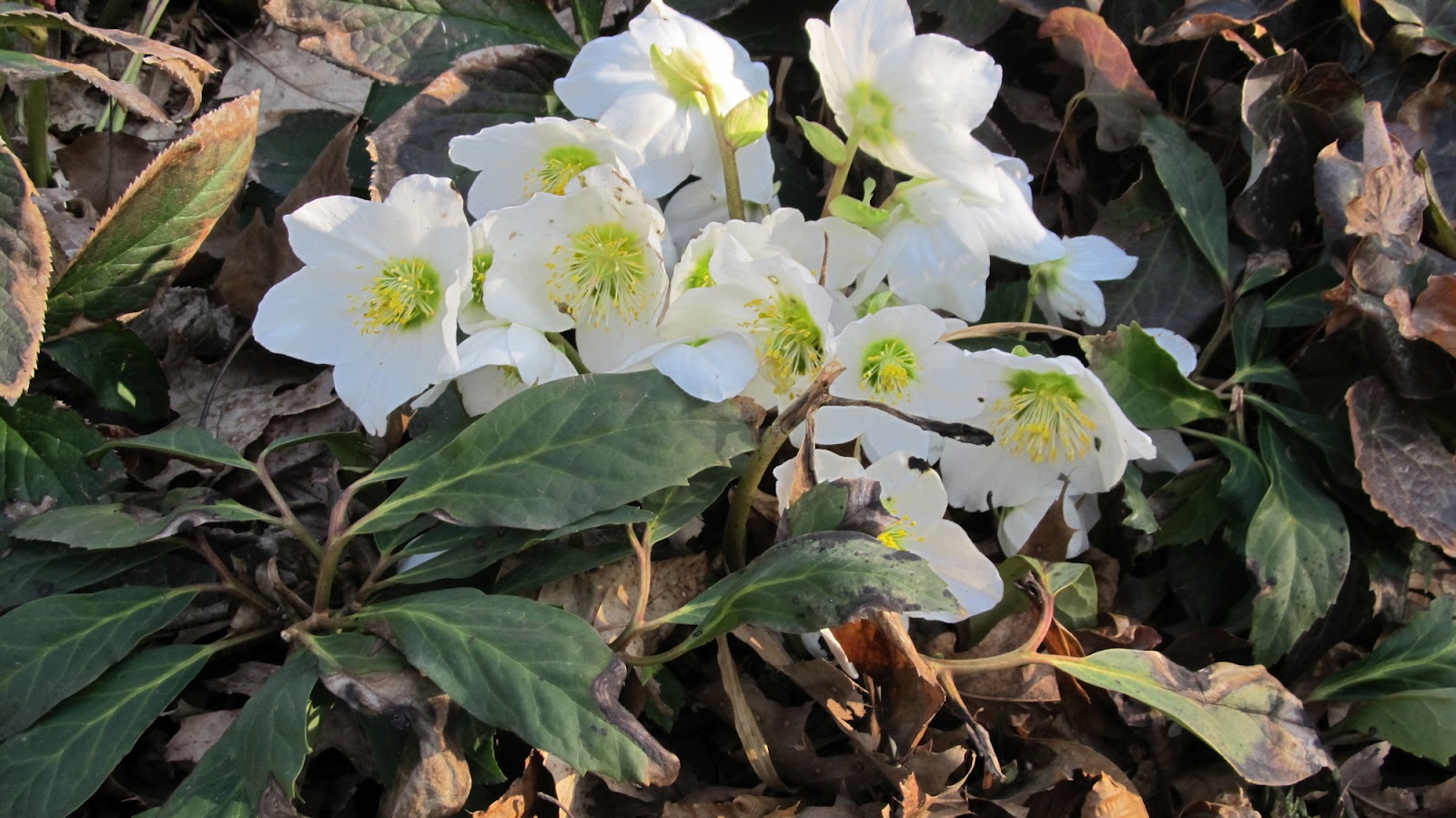
Hellebore - Helleborus Niger - Christmas Rose - Elleboro
and friends and relations

Christmas rose


Many years ago, walking in the hills above Griante, Lake Como, towards a small church with a view, San Martino, we happened upon an unforgettable scene: dozens and dozens of white hellebore growing in a dappled forest. They were so perfect, so abundant and thriving, it was a marvel. The sight is probably not mentioned in the guides because our walk took place at the end of winter, an unusual time for a hike in the hills. I now know that the hellebore were the well-loved Helleborus niger.

The middle to end of winter is when hellebore appears in the woods: first the dark green pointy leaves bursting up from the ground in a bush, then the ranuncula-like open-faced flowers which are white in this case, although many varieties and hybrids are cultivated nowadays and along with the glorious Amaryllis lily, seem to be the flower of the decade

from white to darkest purple

At Le Ripe we are lucky to have two varieties, though not the niger. Spread around our lime-rich woods in pleasing clusters, is the less appealing but still striking Helleborus foetidus, otherwise known as bearsfoot, dungwort and stinking hellebore, which has green, cup-like, drooping blooms edged with purplish red. It turns out not to be stinking at all. Research for this post has led to the satisfying discovery that this native, abundant 'stinking hellebore' is graced with the 'award of garden merit' by the Royal Horticultural Society. So there. 

our very own foetidus - such a shame, the name!

Wednesday, February 27, 2013

The Itinerants

Home and Away

Itinerant tradesmen and merchants in the past in Chianti

onion sellers


When older locals talk about the past, they often mention the itinerant workers and merchants who travelled through the area on foot or via infrequent buses. The ritual January killing of the pig occurred when the norcino pork butcher arrived carrying two satchels across his chest, one filled with spices and the other with the equipment to do the job. The norcino passed from one house to the next, staying overnight at each, working with the farm households to prepare the salami, hams and the various cuts of meat. At the end of the day everyone would celebrate with a special meal.

norcino's produce

Old people also talk about how a spice seller from Siena used to bring the mixed spices to the villages so that cooks could bake cavallucci, migliaccio and other native Sienese treats in the wood-fired oven after making the bread.

cavallucci
migliaccio

Once when Cappelli the Greve blacksmith (who does wonders with wrought iron) visited Le Ripe he told me how he and his grandfather (whom he called mio povero nonno, my poor grandfather), walked from Greve every year with their nanny goat to have her impregnated by the billy goat at Le Ripe....They walked the 14 kilometres to Le Ripe with the nanny goat, returned home on the bus, came back a week later and walked home again....That was simply how it was done.

billy goat

Saturday, February 23, 2013

Water

Water IV

The Supply at Le Ripe

Our drinking, washing, and for now, irrigating water (more on this in a later post on Water) all comes from an 80 metre-deep well drilled in 2006 which is situated on the hill about 50 metres above the house. When the engineer who oversaw our works asked us to choose between a water diviner and a geologist we opted for the latter. He got it right. Apparently there is a lot of water in our hill (there's water in them thar hills) so either option would probably have come up with the goods, as long as they dug deep enough.

well drilling project
The well is not the attractive, ding dong dell pussy's in the well, built-in-stone sort, but an entirely utilitarian concrete one with a heavy manhole-type lid; the water is drawn up by an electric pump. The first pump died after about only two years. When we tried to replace it we realized that the cyinder you can see in the project above encasing the water pipe was in fact a series of metal cylinders screwed one into the other. To pull out the pump this contraption had to be removed using a crane, so that the heavy cylinders could be unscrewed one by one. The man who installed the pump was not available at the time, but luckily our builders and their crane were still with us, and we took the opportunity to replace the metal cylinders with a more modern, flexible rubber one which can be removed easily while the pump is pulled out.

Le Ripe's unpicturesque concrete well, one cistus plant to right
Each year we have the well water analysed chemically and bacteriologically. The results tell us that our water is sound from both points of view even though it is very hard water (alkaline, with a lot of lime). This is good for bones of course but not so good for kidneys. More on our drinking water later.

We have attempted to conceal the well with cistus bushes but for some reason they are painfully slow to grow: however over this last season they showed more oomph...In any case the well and the compost bin are hidden to some extent by the vegie patch fence and creepers. 

white cistus which should one day conceal the well - we live in hope...

 ...content by De Rerum Natura

Tuesday, February 19, 2013

Oh dear the deer


The Beautiful Ratbags

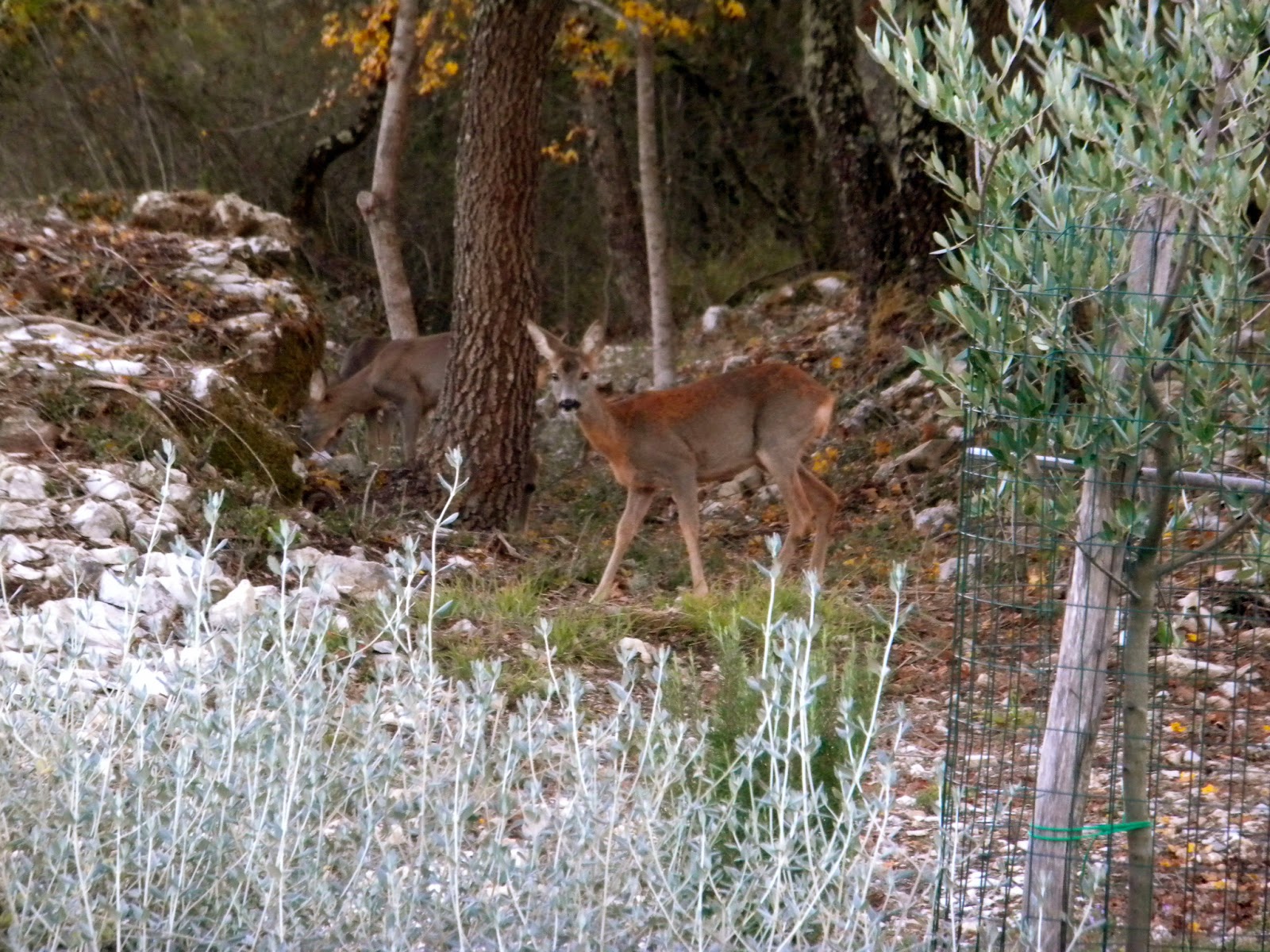
roe doe in late October; note canny cage on right, protecting olive
They are graceful, fleet of foot, soft-eyed and timid. Yet they pose a dilemma.

At first it appears that Dama dama or fallow deer are not indigenous to our region, for they were not in Chianti during the childhoods of older people alive today, when, I have been assured, the only large mammals were hare, fox and badger. Even the porcupine was introduced relatively recently; hence the current dearth of giaggioli, common irises, which used to fill the surrounding countryside, for porcupines adore tubers. 

Fallow deer, rather, were introduced or probably re-introduced, or perhaps returned for lack of predators (see below) since Wikipedia tells us they were native to most of Europe during the last Interglacial, while at the beginning of the Holocene they inhabited the Middle East and some parts of the Mediterranean. We have to blame the Romans for bringing them back to central Europe. Precisely where Chianti stands in this scheme of things is unclear. But these deer have certainly been around a lot longer than we like to think. 

As for the roe deer, Capreolus capreolus, which are stronger and even more agile than fallow deer, jumping higher and faster despite being considerably smaller, they seem to be pretty well indigenous to Eurasia (with the exception of Ireland and smaller islands). However I note: "in the Mediterranean region [they are] largely confined to mountainous regions, and [are] absent or rare at low levels". Our part of Chianti is not mountainous, it is hilly (Le Ripe stands at 330m above sea level), so why have the deer descended below their usual terrain to bother us?


roe deer fawn (roe is the original Bambi) hidden in undergrowth by doe - this location is surprisingly close to our house