Wednesday, February 6, 2013

Primulas

Primula or Polyanthus,
Primula Hortensis,
Primula!

Your native cousins primula vulgaris or primroses will be appearing before too long beside the streams and in the woods at Le Ripe, but I am impatient and couldn't resist your splash of cheering colour on a winter's day.


Chianina Cattle


A Noble Bovine Breed


 Whenever I glimpsed the Chianina cattle,  indigenous to central Italy, in old photos, occasionally at country fairs and rarely at pasture, I was always struck by their massive yet elegant build. A quick search on internet reveals that they are in fact the largest cattle breed in the world. The average Chianina cow stands 150-160 cm at the withers and weighs 800-1,000 kg, while the bull measures 160-175 cm, weighing 1,150-1,280 kg. Massive.

And elegant: they are near-white, long-legged and have beautifully-shaped heads, large eyes and long lashes which stand out against the white. 

It is also amongst the oldest breeds of cattle in the world, probably originating in ancient Roman times. Formerly used as a draught breed, (apparently at one time at Le Ripe there were two 'bovi' or oxen, as they called them), now they are bred almost exclusively for meat. The bistecca alla fiorentina is traditionally theirs.

Yesterday I was lucky enough to be invited to visit a nearby farm which breeds Chianina for the market. This was the setting, in the famous conca d'oro or 'golden basin' of Panzano. The day was overcast, but the scene is beautiful nonetheless.


Tuesday, February 5, 2013

Carnival fare

Cenci, chiacchiere and frappe

A friend has written to remind me that now is the time for cenci.  In Italian cenci are rags or dusters but at this time of year we are talking about something else entirely. 

Now that we are in the upswing to Carnival (Shrove Tuesday or Mardi Gras) and before the downswing to penitential Lent, the locals are making cenci, which resemble rags but taste of the ingredients of the season. They are made of egg, flour, orange peel, Grand Marnier and baking powder. The resulting dough is rolled out thin, cut into ragged strips, which are deep-fried in oil and dusted with icing sugar. The frying is what associates them with Carnival, rather like pancakes for Pancake Tuesday, and is what makes them so delicious. Often a baked version is also available...but less wonderful. In Milan they are called chiacchiere, 'chatter' and in other parts of Italy they are called frappe.


Here is a genuine recipe for 'Rags' from Anna Guarducci, an excellent cook from Panzano. We hope to have a photo of hers soon; in the meantime, here are some (which were - I stress the past tense - truly delicious) from Panzano's pasticceria Sieni:

cenci, chiacchiere or frappe for carnival on typical pasticceria's tray


Cenci (Rags)

500 g (18 oz., 3 1/2 cups) all purpose white flour
3 large eggs
3 tablespoons  sugar
2 Tablespoons confectioners'/icing sugar
1 inner part of a vanilla bean
grated zest and juice of 1 orange
1/8 cup Grand Marnier
100 ml cream
4 tspns baking powder
2 litres (2 US quarts) peanut oil for deep frying
confectioners'/icing sugar for dusting

1. Weigh flour into a large bowl and make a well
2. Dissolve baking powder in cream over low heat and cool
3. In the centre of the well, combine the eggs, sugar, confectioners' sugar, inner part of the vanilla bean, grated zest and juice of an orange, Grand Marnier and cream with baking powder and cream
4. Gradually incorporate the ingredients in the well with the flour and knead to form a smooth, soft dough
5. Pour the peanut oil into a heavy 3 quart (3 litre) saucepan and heat to 375° F (190° C).
6. Break off pieces of dough and roll out one at a time on a lightly floured surface until 1/8 inch (.3 cm) thick.  With fluted pastry wheel, cut the dough into roughly shaped pieces that look like rags.
7. Lower the pieces into the oil and fry until golden on both sides. Remove the cenci with a wire skimmer, drain and dust with confectioners' sugar. 

They are best when warm, delicious on the day they are made, but will keep in an airtight container...if you can keep your hands off them!


With many thanks to a friend for supplying recipe, text and translation...


Monday, February 4, 2013

Dario Cecchini

La Repubblica Gastronomica di Panzano


cow outside Cecchini's restaurant


A new Republic has been declared in the township of Panzano.

Our famous, some would say notorious butcher, Dario Cecchini, featured in international newspapers, including the New York Times, who challenged the monopoly of MacDonalds with his own brand of hamburger called MacDario (a name the US food giant blocked, threatening to sue him), a natural showman and provocateur, has now attached an enormous emblem/installation/homage to meat to the wall of his restaurant, 
a virtual Declaration of Intention:
the motto, Partito Consumista, requires no gloss.


Installations on restaurant wall. They are illuminated at night.

Pergola


The Pergola

This has been assembled, mounted, soldered and finished in stages by our local blacksmith. 
He usually works on farm equipment and machinery so I think he welcomed the chance to do something more aesthetically pleasing. Tillo was born near Lucarelli, on the hill opposite Le Ripe. Once he visited with his wife and family and a friend who had lived at Le Ripe: a tale to tell another time.

Here you can see half the pergola being raised...
...then the other half...
 The blacksmith solders all the movable parts,
adds the traditional curlicues,


Ed eccola! The finished product...


We shall plant four grapevines to grow over it, even though I know we shall have to spray them with copper sulphate if we want a harvest...It will be lovely to be able to eat outside in the shade in summer. We have told Tillo he must come back with his friends to have a glass of wine under his pergola....and I believe he will.

Sunday, February 3, 2013

Water

Water II


Borro delle Ripe

Borro delle Ripacce


At le Ripe there are two streams which carry water down the hill towards the Pesa. The Pesa is a 'torrente' or ephemeral river, which means that it dries up or goes underground in the summer months. 
 The two streams can be seen on this map from the Catasto Leopoldino, the land register in Siena which dates back to the late 18th and early 19th centuries. Le Ripe was called Le Ripacce then.
In the Catasto today's borro delle Ripe was fosso del Nicione and the borro delle Ripacce was fosso delle Stinche. 

original land registry map with two streams in bottom right hand corner: 
the Pesa is at the top of map
 

The day before we returned home last November, a tremendous rainstorm had inundated the hill.The two streams overflowed and swept stones and earth every which way. 

For one account of this event, see our post for Saturday December 1st 2012. 
For another, more classical and poetic account of such phenomena, 
read below.


"...sunt igitur venti ni mirum corpora caeca,
quae mare, quae terras, quae denique nubila caeli
verrunt ac subito vexantia turbine raptant,
nec ratione fluunt alia stragemque propagant             

et cum mollis aquae fertur natura repente
flumine abundanti, quam largis imbribus auget
montibus ex altis magnus decursus aquai
fragmina coniciens silvarum arbustaque tota,
nec validi possunt pontes venientis aquai              

vim subitam tolerare: ita magno turbidus imbri
molibus incurrit validis cum viribus amnis,
dat sonitu magno stragem volvitque sub undis
grandia saxa, ruit qua quidquid fluctibus obstat."

"....the winds,
'Tis clear, are sightless bodies sweeping through
The sea, the lands, the clouds along the sky,
Vexing and whirling and seizing all amain;
And forth they flow and pile destruction round,
Even as the water's soft and supple bulk
Becoming a river of abounding floods,
Which a wide downpour from the lofty hills
Swells with big showers, dashes headlong down
Fragments of woodland and whole branching trees;
Nor can the solid bridges bide the shock
As on the waters whelm: the turbulent stream,
Strong with a hundred rains, beats round the piers,
Crashes with havoc, and rolls beneath its waves
Down-toppled masonry and ponderous stone,
Hurling away whatever would oppose."


Lucretius, De Rerum Natura Book I Verses 277-289
trans. William Ellery Leonard (1876 - 1944)

...content by De Rerum Natura 

The Laundered Sky

Blued with Blue


I promise 
I have not 'enhanced' these photos with that 
handy function which tends to improve images.
This is their true colour, pure and simple.

This morning it looked as though the sky had been freshly laundered and tinged with 'blue'. Does anyone recall those little muslin packets of blue dye which were used in the past to make white linen look whiter?
I think the sky was rinsed with that today 
and someone overdid the dose.

Lavender Bags

Whatever happened to all the lavender?


It has taken a while, but with the help of a neighbour, who takes her embroidery to country fairs in the area, we have finally produced a first lot of lavender bags filled with Le Ripe lavender
(DOC) which will be gifted to guests.
This lot is in a traditional style: soon there will be a contemporary version as well.


Aren't they pretty!

Saturday, February 2, 2013

Water


Water I


Fortunately there is a lot of water at Le Ripe.


Le Ripe fishpond with Niji, our only remaining koi, saying hello 


http://philosophyphs.weebly.com/uploads/4/4/1/5/4415202/2652411.jpg
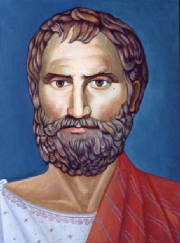
Thales of Miletus c. 624 BC – c. 546 BC


The first scientist philosopher, Thales of Miletus, considered water nature's fundamental substance.

"The much-discussed four substances - of which we say the chief is Water, making it as it were the one Element - by combination and solidification and coagulation of the substances in the universe mingle with one another. In what way, I have already explained in Book One."

                                                                                          Thales DK 11B3 (Galen)

Thursday, January 31, 2013

Birds in Winter

a bird ballet


starling (sturnus vulgaris) planning today's choreography

Two winters ago I was in the parking lot in Greve in Chianti towards dusk. A loud chirping and rush of wings made me look up at the darkening sky. Thousands of birds were streaming and wheeling above me, calling and settling on surrounding trees then rising again. I stood there fascinated, surprised that no one else seemed to bother with this scene. On asking a passerby what the birds were I was told "storni" which is starlings.Of course the locals see the birds every year, they are commonplace, like pigeons in the city. Still.

Just yesterday I was working near our vegie patch when a very sudden and loud gushing, whooshing noise from a little higher up the hill startled me. My first thought was of a mass of water released from a dam or pool. Of course we have no such thing, but that was precisely what it sounded like.

Seconds later a host of starlings rose into the air from behind a stand of trees. There must have been hundreds. As they wheeled and turned in the sky their wings whirred and almost sang.

Just today on the Italian paper il Corriere della Sera, this film was published, which I have tracked to YouTube. It doesn't reproduce the sounds I heard but it does record the extraordinary annual dance of the starlings. 

http://www.youtube.com/watch?v=XV9wOTqOQw0
 
Here is a reference from the International Business Times 
which explains more ... 

"...breathtaking phenomenon called murmurations. This is when a huge flock of birds that are in migration form a magical shape-shifting flight pattern in the sky. The birds tend to flock together for protection and can reach speeds of up to 20 mph/32kph...Scientists aren't sure how the starlings do their complex dance...the birds have a quicksilver reaction time of under 100 milliseconds, which prevents them from colliding with each other in the air."


This is another clip which apparently has gone 'viral'; it includes some scientific explanations of the starlings' startling steering abilities.

Here instead is a curiosity regarding one starling and Mozart. It appears that the birds are excellent mimics: 


Aconites

First signs?


winter aconite - eranthus hyemalis - pie' di gallina

Is it too soon to hope? The winter aconites would seem to say no. The weather has been sunny and mild, yet it is only the end of January....According to my (extensive) records, they usually appear in February, so are indeed a little early this year. Delightful, bright blooms to cheer us in the latter half of winter. The Italian name means hen's foot: quite descriptive really.

Monday, January 28, 2013

Pruning

Reflections on Pruning


well-pruned mulberry

Pruning 
can be a pleasing activity:
removing the dead stems, 
the leaves that might spread infection, 
cutting the shrub or tree back to its bare essentials, 
anticipating, through the exercise, 
an abundant leafing and flowering in spring.
It is a complex art, since each species or variety 
can react differently to the cut,
and weighty decisions must be taken.
Although I plan to buy an electric hedge trimmer,
since forty lavender bushes, 
numerous shrubs 
and burgeoning hedges
exact much labour,
I am aware that some of that fine pleasure will be lost.