Thursday, October 25, 2012

Nahema Roses


It is the 25th of October and there was this beauty in the garden. 
Or rather, in the vegie patch, since the roses have had to take refuge there from the deer. 
They are mostly Nahema with its glorious lemon-apricot perfume. I rarely pick the roses, but it is the end of the season and it may soon rain and spoil them...
Such a joy.

Wednesday, October 10, 2012

Boring Boars

 Grubbing around
They're at it again. The first sign is holes in the grass or furrows in the earth, but this year they've outdone themselves. They have re-ploughed stretches of our neighbours' lawn, re-dug the water channel along our road and excavated the river banks. 

The wild boar are in a feeding frenzy. It must be grubs and roots they're after. They've dug virtual ditches along the road and tossed earth all over the place.

Not my own photo: thank-you internet!

We live alongside the wild boar. They're not native to Chianti, but then neither are we. Introduced from game reserves and then crossed with a Hungarian variety, they are huge. Trundling around in the woods in their family groups (mothers and piglets) looking for food, they don't bother us. I've learnt to recognise the cracking and rustling of their passage through the undergrowth, but hardly ever see them. 

In summer when the wild plums ripen it's fun to go out at night and hear them crunching up the plums, stones and all. In autumn they hoover up berries, tubers, grubs. In winter they thrive on acorns and chestnuts. 

When we first arrived at Le Ripe we had the future orchard ploughed, in a manner of speaking, by the builder's digger. Then we sowed beans and peas to enrich the earth. I only hope they had time to enrich the earth because no sooner did the peapods sprout, the plants disappeared. I actually spied the Sus Scrofa family enjoying its picnic of tender peas. What a treat!

Monday, October 8, 2012

Peculiar Pig

More about pigs
Further down the blog is a post about Tuscan pigs. 
But yesterday in Panzano we saw a little girl walking a pig on a lead. 
The girl was very small and the pig was even smaller. It was not a cinta senese, although the markings were similar, but some dwarf breed. 
The little girl was unhappy about being photographed,
but the pig seemed quite relaxed.
An unusual sight in Panzano.


Heroes

L'Eroica

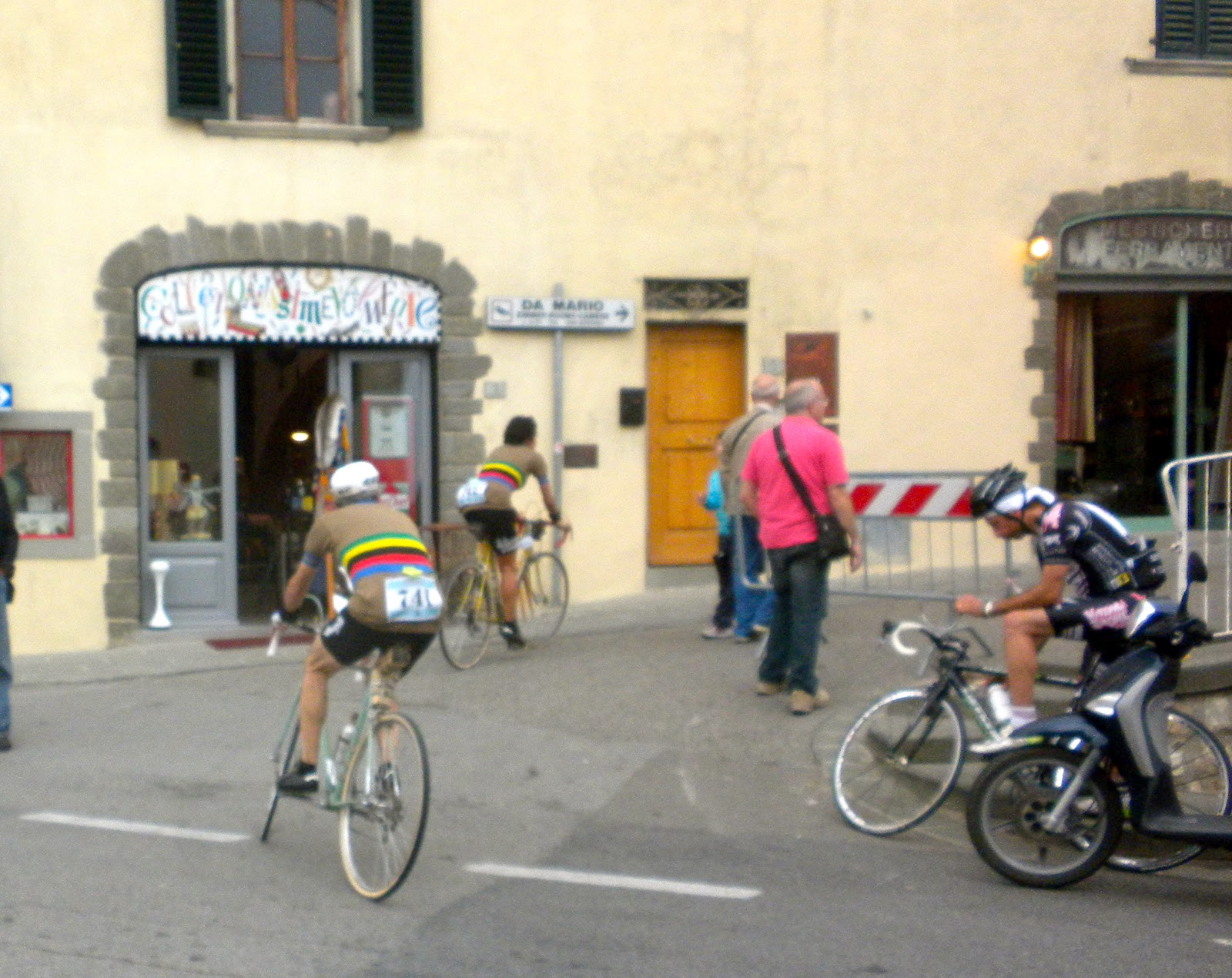
We are not talking about Beethoven's Eroica but a bike race with a difference. Every first Sunday in October cyclists from all over Europe come to Chianti to take part in L' Eroica


The condition for participation is that bike models used should date from 1986 or earlier.  Many cyclists even wear the old gear, and carry spare tires slung over their shoulders. The race for the keenest is 205 kilometres long while the shortest is 35 kilometres. 


Either way the cyclists have to deal with hilly terrain and some unsealed roads, as well as older bike technology. 

We were at Panzano for the Festa Aprilante, the monthly food and crafts fair, and managed to see quite a few brave souls pedal past. 


Cecchini, our famous local butcher, was on hand as usual to offer refreshments. We were amused to see the cyclists scoffing wine and bread smeared with Cecchini's herbed lard!


Useful calories I suppose.


There were quite a few vintage cars around too as well as this two-wheeled vintage interloper...

Apparently 5,000 cyclists took part in L'Eroica this year: che eroi!


Wednesday, October 3, 2012

Quinces

First signs
Autumn has come to the hills, very gently. The first signs are wisps of mist, dew on grass and leaves in the early morning, colours starting to turn. When I passed the orchard this morning I noticed the branches of the quince tree bending low. The quinces were large and heavy, pleading to be harvested. 


Although they are not quite 
ripe, they can be kept on a windowsill inside to ripen slowly and perfume the room. The ones that were addled I cut and cooked with a little sugar into a thick puree which will be preserved in jars to eat with cheese, roasted meat and Greek yogurt...


The quince is a fascinating fruit, with a venerable ancestry. It originated in Asia Minor and was brought to Europe by the Greeks and Romans and was cultivated in medieval gardens. Quince comfits, cubes of sweet quince paste, are still made and eaten in southern Europe to this day. When my husband went to school in Naples, his mother often gave him quince comfits, or cotognata for a treat. A far cry from a Mars bar!

Sunday, September 30, 2012

Fabulous Figs

A little seasonal bounty
It's the figs I want to talk about. We have several good trees but luckily the best one is near the house. Its figs mature in September, are greenish yellow without and mostly deep, glistening red within. When they are ripe it's like eating jam. This year the other trees bore little fruit, possibly because the summer was so dry. But since I water around the house tree in any case, its crop was abundant this year as well. Every other day you can be sure of a basketful.

In good years we don't know what to do with them all. This year, and thanks to a series of house-guests, they have all been eaten fresh from the tree. Last year I made fig jam (you need very little sugar) and bottled the puree, without sugar, for eating with cheese and meats:very good! Single peeled figs wrapped in a thin leaf of prosciutto crudo is a very delicious appetizer; quartered but left to stand on a bed of leaves with pieces of fresh pecorino (sheep's milk) cheese and a little thyme, some honey drizzled on top, is another lovely way to go, taught me by an Australian friend who visited recently.

In the past, I am told, the bottom of the burgeoning figs would be painted with a little donkey urine to keep away insects and blight; although our figs receive no such treatment we still cut off the base before eating. I'm not sure if it's because there might be insects, or because we're worried someone might have treated them on the sly!

The Italians have an elegant way of eating figs: since they generally avoid eating the skin, they hold the fig by its stem, cut through the base to divide the fruit almost in quarters; the result is an opening flower. They then bite off each quarter, peeling it off the skin as they go. The skin is discarded.

Monday, September 24, 2012

Cinta Senese


Historical Pigs 
The cinta senese is a handsome pig, bred in these parts for centuries. The distinctive white band tends to include the forelegs.  This pig lives in the oak and chestnut wooded hills around Siena and is prized for the sausages, hams and salame it provides. There is a small farm of cinta senese beside the unsealed road on the ridge east of Le Ripe.


The internet will tell you that the British saddleback, which resembles the cinta, is a 20th century breed, but there is documented proof of the Sienese cinta's antiquity.


detail from wall depicting effects of good government


Visit the Palazzo del Popolo in Siena, as you must,
and you will find the breed enshrined in a glorious fresco by Ambrogio Lorenzetti in the Hall of the Nine, the council chamber where the nine city councillors of the day would meet.
wall depicting allegory of good government


The fresco dates back to
1340 and on two large walls, depicts the Allegory and Effects of Good Government, a concept refreshing still today and surprising for its solid, secular awareness almost 700 years ago. It is interesting that the Judge is surrounded by female figures: Peace, reclining on her bench; Justice on her throne with Virtue at her feet; Wisdom floating above her head as well as many others.

Saturday, September 15, 2012

Apes in Tuscany


Apes
What does an ape have to do with Tuscany, you might ask. Not much, on the surface. But a recent story in the news about the discovery of this wonderful 'new' ape in the Congo, the Cercopithecus lomamiensis, prompts a look at some of Tuscany's recent and ancient local history.

If you drive to Radda along the valley road from Le Ripe, about halfway along you will see a sign indicating the 'Fonte di Selvolina' which is the spring of Selvolina, an ancient spring where locals would come to fill their bottles or barrels with good water and where travellers could refresh themselves and their beasts of burden. The spring today emerges in a rather battered stone trough right by the side of the road.

One day not so long ago, passersby were amazed to see a monkey perched on the trough. A small, thirsty monkey who had found a welcome place to have a drink. It was thought the monkey had escaped from some private zoo. I don't know whether the monkey was caught or whether it survived for a while in the Chianti hills, living off berries and grapes; certainly it has no natural predators in this area, if you don't count humans.

But the story does not finish there. It appears that in the ancient past, in prehistoric times, apes did roam through western Tuscany, when this land was a tropical island. The remains of a curious primate, the Oreopithecus Bambolii (named after Montebamboli, one of the sites where it was found) have led scientists to infer that this ape may have walked on two legs at times, and was capable of manual dexterity like humans. All of which is rather extraordinary and thought-provoking. 


For more information, have a look at these links.


Friday, September 14, 2012

Sky Show

Today was a day of moving skies, 
the wind whipping white and grey clouds 
across an elusive blue. 
The photo was taken just before sunset, 
a magical time of day when our hill is already shadowed, 
but the hills opposite are lit up, golden.
On a day like this you really should just 
stay outside and watch the show.

Wednesday, September 12, 2012

Selva Oscura


from Gustave Doré's Inferno
  Dark Woods

 Nel mezzo del cammin di nostra vita
mi ritrovai per una selva oscura
ché la diritta via era smarrita.
  Ahi quanto a dir qual era è cosa dura
esta selva selvaggia e aspra e forte
che nel pensier rinova la paura!

Midway on our life's journey, I found myself
In dark woods, the right road lost. To tell
About those woods is hard—so tangled and rough 
And savage that thinking of it now, I feel
The old fear stirring... (trans. Pinsky)

Not exactly a jolly post, but not without a point either. Dante Alighieri, who wrote these immortal lines, lived and breathed the air of this land in the late 13th and early 14th centuries. At Le Ripe we have such a 'dark wood' on our property, where we do not like to roam: it is north-facing, dank and the trees have been abandoned to themselves to grow tall and fall in storms. Yet it is a fragment of wilderness where porcupines, deer, boar and all the other creatures find refuge.
Dante is using the dark wood as a metaphor for a difficult moment in his life and these lines are the opening to his masterpiece La Divina Commedia. I studied Dante's Commedia many years ago; amongst other things it introduced me to the marvels of medieval Tuscany, echoes of which linger in our hills to this day.

All this was brought to mind by a delightful entry in our Visitors' Book, which I quote in part:

Midway through the potholes on the steep way
Where the straight path is lost in darkling woods
We longed to see the lights of Le Ripe
Promising cheer and warmth and other goods
Books, talk, food and suites....  

Wednesday, September 5, 2012

The Best Minestrone

Panzano market produce
Minestrone
Panzano Sunday market has few stalls, but the cheese stall and the fruit and veg are excellent. We don't go every Sunday, but when we do, we aim for early. In summer by 10 not only is the place seething with tourists, but the best produce has long gone. We usually treat ourselves to a fine coffee at the corner cafe', then launch ourselves on the stalls. 
Last Sunday we bought fresh 
mozzarella which is 
raw minestrone
superlative, as good as you can get in Naples, crusty bread which was still hot and loads of fruit and vegetables. The peaches and nectarines we bought are not featured in these photos, but they are still very good; and now grapes and figs are in season. We prefer uva Italia which is a moscato (muscat) variety, and although we have figs on our own trees, we buy some...just in case. The second photo is a portrait of a raw minestrone. Fifteen vegetables went into its making, including cannellini beans. Minestrone is really an excuse for ribollita, the hearty Tuscan soup based on the day-before's minestrone (ribollita just means 'reboiled'), with local bread stirred into it, served with olive oil, pepper and parmesan. A one-pot meal if ever there was one. To make a true ribollita the two essential ingredients are cannellini beans and cavolo nero, or Tuscan black kale. I try to make enough to last at least two meals. If it were just for me, I could live on ribollita...

Friday, August 31, 2012

Rain at last


Relief

Rain! At last, after two months of drought, we were regaled with a substantial rainfall this morning, complete with marvellous rumbles of thunder.


Everyone in the valley, probably in the whole of Tuscany, is relieved. The forecasts promise more and today after it cleared I pulled out my first weeds of the rainy season. 
I have had my eye on them for weeks; but it is pointless weeding a dry garden.


The animals in the woods will be relieved too: maybe the predatory deer and marauding wild boar will be distracted by puddles and newly-succulent greenery...we live in hope!